
Sea Salt vs Himalayan Salt: The Differences in Mineral Composition, Flavor Profiles, and Culinary Utility
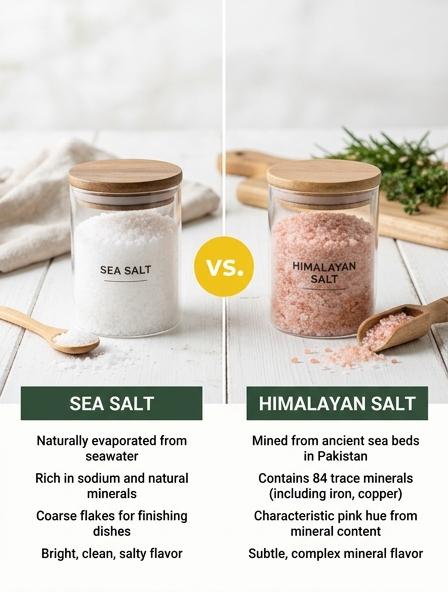
Flavor profiles and sensory impact on home cooked meals
Distinguishing between sea salt and Himalayan salt goes beyond aesthetics; it involves understanding how their distinct mineral compositions influence the palate. Sea salt, harvested from evaporated seawater, typically offers a sharp, briny punch that enhances the natural savory notes of fresh ingredients. In contrast, pink Himalayan salt, mined from ancient seabeds, provides a more subtle, earthy flavor due to its trace minerals like iron oxide and magnesium.
- Sea Salt: Provides a bright, clean finish with varying textures like large flakes or coarse crystals.
- Himalayan Salt: Offers mild, complex undertones with a signature, lingering crunch and a softer saltiness.
The sensory impact depends heavily on grain size and mineral concentration, which dictates how quickly the salt dissolves on the tongue during a meal. You might prefer a pinch of flaky sea salt to provide a clean oceanic crunch to grilled salmon, or choose finely ground Himalayan salt to add a mellow, mineral-rich depth to a batch of dark chocolate brownies.
Nutritional Composition and Mineral Benefits for Families
When comparing sea salt and Himalayan salt, the primary difference lies in their mineral density and extraction methods. Sea salt is produced through the evaporation of ocean water, retaining trace amounts of potassium, iron, and zinc. Himalayan pink salt is mined from ancient seabeds and is celebrated for containing up to 84 different trace minerals, including magnesium and calcium, which contribute to its distinct color.
- Sea Salt: High in essential electrolytes for hydration.
- Himalayan Salt: Rich in iron oxide and sulfate for metabolic support.
For health-conscious families, these unrefined salts offer a cleaner alternative to processed table salt, as they typically lack heavy anti-caking agents and artificial additives. Choosing mineral-rich salts helps maintain the body's fluid balance and supports nervous system health during daily activities. You might enjoy finishing a grilled family dinner with a sprinkle of flaky sea salt to enhance the natural flavors while providing your children with necessary trace elements for their growth.
Texture Variations and Their Influence on Seasoning
The physical structure of sea salt and Himalayan salt dictates how they interact with food and the palate. Sea salt often features a flaky, irregular shape or thin crystals that dissolve quickly, making it ideal for immediate flavor integration. Conversely, Himalayan pink salt is typically characterized by dense, cubic crystals that are harder and slower to melt. These structural differences determine the "saltiness perception" during the eating process.
- Sea Salt: Known for a delicate "pop" of salinity and rapid solubility in moist environments.
- Himalayan Salt: Offers a consistent, lingering saltiness and is the preferred choice for salt blocks or grinders.
The choice of texture can transform a dish; for instance, many home cooks love finishing a decadent dark chocolate tart with a pinch of flaky sea salt to create a sharp, crunchy contrast against the smooth sweetness.
Solubility Levels in Liquid-Based Recipes
Solubility plays a critical role in how flavors distribute within liquid-based recipes. Sea salt generally offers higher solubility due to its less dense crystal structure, making it ideal for quick-incorporation tasks like salting pasta water or creating light broths. Conversely, Himalayan pink salt possesses a more complex mineral profile and denser crystalline form, which can lead to a slightly slower dissolution rate in cold or room-temperature liquids.
| Salt Variety | Dissolving Speed | Optimal Liquid Use |
|---|---|---|
| Sea Salt | Fast | Brines and quick sauces |
| Himalayan Salt | Moderate | Slow-simmered soups and stews |
You will likely prefer fine-grain sea salt when whisking a delicate vinaigrette to ensure the crystals fully vanish into the emulsion for a perfectly smooth texture.
Sodium Density and Potential Health Considerations
Both sea salt and Himalayan salt are primarily composed of sodium chloride, typically hovering around 98%. While Himalayan salt is often marketed as a "healthier" alternative due to trace minerals like iron and potassium, the sodium density remains nearly identical to sea salt. The primary difference in dietary intake often stems from crystal size; larger Himalayan crystals occupy more volume, leading to less sodium per spoonful compared to fine-grain sea salt.
| Feature | Sea Salt | Himalayan Salt |
|---|---|---|
| Sodium Content | ~98% | ~98% |
| Trace Minerals | Variable | Higher (Iron/Magnesium) |
Excessive intake of either variety can contribute to hypertension, so moderation is vital regardless of the mineral profile. Fitness enthusiasts often reach for a pinch of pink Himalayan salt in their pre-workout water to support electrolyte balance without the additives found in processed table salt.
Production Methods and Environmental Sustainability
The environmental impact of salt depends largely on its origin and extraction process. Sea salt is typically produced through solar evaporation, where sun and wind dry seawater in large coastal ponds. While this method is naturally renewable and energy-efficient, the increasing presence of microplastics in modern oceans poses a sustainability challenge regarding purity.
- Sea Salt: Harvested from active oceans; renewable but susceptible to marine pollutants.
- Himalayan Salt: Extracted from ancient inland mines; non-renewable with higher transport emissions.
Himalayan pink salt is mechanically mined from ancient seabeds in Pakistan. Because these deposits are millions of years old, they are free from modern toxins. However, mining is a finite resource-intensive process, and the carbon footprint is significantly higher due to the heavy machinery used and the long-distance global shipping required.
You might opt for locally harvested sea salt to minimize your carbon footprint during weeknight meal prep, or choose the pristine, hand-mined pink crystals when you want a decorative, mineral-rich finish for a gourmet dinner party.
Hygroscopic Properties and Food Preservation Effects
Both sea salt and Himalayan pink salt possess hygroscopic properties, meaning they naturally attract and absorb moisture from their surroundings. This characteristic is vital in food preservation, as it facilitates osmosis-a process where salt draws water out of microbial cells to prevent bacterial growth and spoilage. While their chemical sodium chloride content is comparable, their physical structures offer distinct preservation advantages:
- Sea Salt: Typically features a higher residual moisture content from evaporated seawater, making it ideal for creating quick brines and preserving fermented vegetables.
- Himalayan Salt: Known for its exceptional dryness and dense crystal matrix, it provides superior moisture-wicking capabilities for long-term dry-aging.
The efficacy of each salt depends on the required rate of dehydration and the desired mineral infusion in the final product. You might reach for sea salt when preparing a quick brine for pickles to ensure rapid dissolution, while using Himalayan salt blocks for long-term dry-aging of beef to achieve a concentrated, savory depth.
Color variations and visual presentation on the table
The aesthetic appeal of salt often dictates its use in gourmet plating and tabletop presentation. Sea salt typically presents as a clean, bright white, though artisanal harvests like French Sel Gris may appear grey due to minerals from clay pond linings. Conversely, Himalayan salt is celebrated for its iconic pink spectrum, ranging from subtle off-white to deep coral, caused by trace amounts of iron oxide.
- Sea Salt: Shimmering white or translucent flakes that offer a minimalist, coastal look.
- Himalayan Salt: Distinctive rosy, earthy tones that provide a rustic and premium feel.
Many hosts love using a clear glass grinder filled with coarse pink Himalayan crystals to provide a sophisticated pop of color that acts as a natural centerpiece during a formal dinner party.
Chemical stability during high temperature preparation
Both sea salt and Himalayan salt demonstrate exceptional chemical stability during high-heat cooking. The primary compound, sodium chloride (NaCl), maintains its molecular integrity up to its melting point of approximately 801°C, which is significantly higher than any residential oven or stovetop capacity.
- Himalayan Salt: Its complex mineral matrix, including iron oxide and potassium, remains largely inert during roasting, though these trace elements may slightly accelerate fat oxidation in specific oils at extreme heats.
- Sea Salt: While the salt itself is stable, trace amounts of organic matter or moisture found in less refined sea salts can undergo minor thermal decomposition or evaporation during intense searing.
Since neither salt produces harmful byproducts or structural breakdown during standard culinary processes, thermal stability is rarely a safety concern for chefs. You might choose the dense, crystalline structure of Himalayan salt for a salt-crust roast to maintain steady thermal insulation without the salt granules breaking down prematurely.
Market Price and Long-term Kitchen Utility
Choosing between sea salt and Himalayan salt involves balancing cost-efficiency with culinary versatility. Sea salt is generally more affordable and accessible, as it is harvested through solar evaporation. This makes it the primary choice for high-volume kitchen utility, such as boiling pasta water or brining poultry. In contrast, Himalayan pink salt carries a premium price tag due to the labor-intensive mining processes in the Punjab region and its status as a gourmet mineral.
- Sea Salt: High cost-efficiency; ideal for daily seasoning and bulk preservation.
- Himalayan Salt: Higher market value; prized for its aesthetic appeal and trace minerals.
Both varieties boast an indefinite shelf life when stored in a cool, dry place, making them stable long-term investments for any pantry. You might use budget-friendly sea salt for your daily cooking needs, but keep a grinder of Himalayan pink salt on the table for guests who love its vibrant color and subtle, earthy crunch on finished dishes.
Sea Salt vs Himalayan Salt source and external links
- Sea salt is produced by the evaporation of seawater and is widely used as a seasoning in foods and as an ingredient in cosmetics.
- Himalayan salt is a pink-hued rock salt mined from the Punjab region of Pakistan that is prized for its mineral content and decorative uses.