
Popcorn Salt vs Salt: Are They The Same? Texture, Solubility, and Surface Adhesion
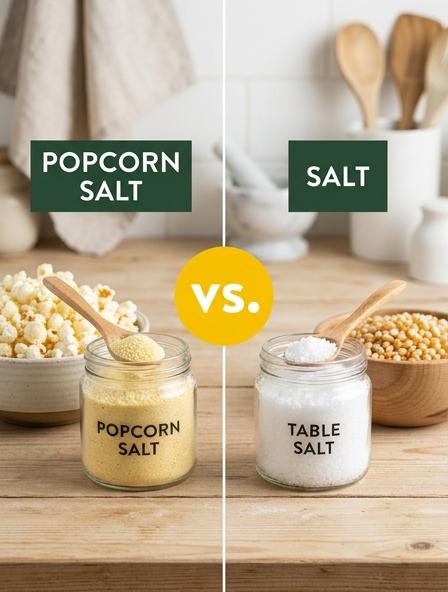
Surface Adhesion and Particle Fineness Comparison
The primary difference between standard table salt and popcorn salt lies in their physical structure. Regular salt features large, cubic crystals that are relatively heavy. When sprinkled on popcorn, gravity and the smooth surface of the kernel cause these large grains to fall to the bottom of the bowl.
Popcorn salt is pulverized into an ultra-fine, flour-like powder. This dramatic increase in surface-area-to-mass ratio allows the particles to defy gravity by clinging to the microscopic oils and crevices on the popcorn's surface.
| Salt Type | Texture | Adhesion Quality |
|---|---|---|
| Table Salt | Granular | Low (slides off) |
| Popcorn Salt | Flour-fine | High (sticks instantly) |
Movie enthusiasts prefer this ultra-fine dusting because it transforms a plain bowl of corn into a professional theater-style snack where the savory flavor actually sticks to every bite.
Sodium Density and Daily Intake Considerations
When comparing popcorn salt to standard table salt, the primary difference lies in physical density. Popcorn salt is ground into a fine "flour" texture. Because these crystals are so small, they pack tightly into a measuring spoon, leading to a higher sodium concentration by volume than coarser varieties.
- Popcorn Salt: Extremely high density; packs tightly with minimal air gaps.
- Table Salt: Moderate density; consistent cubic granules.
- Kosher Salt: Low density; large, hollow flakes that take up more space.
For those managing their daily intake-typically aiming for under 2,300mg-it is crucial to measure carefully, as a level teaspoon of fine popcorn salt contains significantly more sodium than a teaspoon of coarse salt. Many home cooks prefer popcorn salt because its fine dust clings instantly to every nook of a buttered kernel, ensuring every bite delivers that classic cinema flavor without leaving a pile of wasted seasoning at the bottom of the bowl.
Solubility Variations in Hot and Cold Liquids
The primary difference in solubility between popcorn salt and regular salt lies in their particle size. While temperature is a major factor in how quickly sodium chloride dissolves, surface area determines the rate of integration. Popcorn salt, often referred to as "flour salt," features ultra-fine grains that dissolve significantly faster than standard table salt.
- Hot Liquids: In heated fats or boiling water, the high kinetic energy allows both salts to dissolve, but popcorn salt integrates almost instantaneously.
- Cold Liquids: Regular salt crystals often struggle to break down in cold oils or chilled dressings, whereas the increased surface area of popcorn salt facilitates rapid dissolution even without heat.
You might prefer using popcorn salt when whisking together a cold vinaigrette or herb-infused oil to ensure the seasoning disappears into the liquid immediately rather than leaving a gritty residue at the bottom of your bowl.
Texture Impact on Prepared Home Meals
The primary distinction between popcorn salt and standard table salt lies in their physical grain size. While table salt features distinct cubic granules, popcorn salt is pulverized into a fine, flour-like powder. This structural difference significantly affects how seasoning interacts with the texture of your home-cooked dishes.
- Dissolution: The increased surface area of fine salt allows it to dissolve instantly in sauces, dressings, or melted butter.
- Adhesion: The powdery texture clings to uneven surfaces and crevices where heavier grains would simply bounce off.
- Mouthfeel: It provides a consistent saltiness throughout a dish without the gritty "crunch" associated with larger crystals.
Home cooks often prefer dusting this micro-fine salt over homemade potato chips or roasted nuts to ensure every bite is evenly seasoned without leaving a sandy residue at the bottom of the bowl.
Even Distribution in Snacks and Fried Foods
The primary difference between popcorn salt and regular table salt lies in particle size. Popcorn salt is pulverized into a fine, flour-like powder, which significantly increases its surface area relative to its weight. This physical property allows the salt to settle into the microscopic crevices of irregular food surfaces, ensuring uniform flavor across every bite.
While standard table salt often bounces off dry snacks or settles at the bottom of the container, the superfine texture of popcorn salt provides superior adhesion. This is particularly effective for:
- Ensuring consistent saltiness without "salty hot spots."
- Increasing cling to oily or fatty surfaces on fried goods.
- Reducing seasoning waste left at the bottom of the serving bowl.
You will notice the difference when you toss hot, crispy French fries in this fine powder and every single fry tastes perfectly seasoned from tip to tip.
Volume Measurement Disparity and Recipe Accuracy
The primary difference between popcorn salt and regular salt lies in their particle size. Popcorn salt is pulverized into a superfine, flour-like powder to ensure it sticks to the nooks and crannies of every kernel. However, this creates a major volume measurement disparity because fine particles pack more densely than large granules.
- Standard Salt: Larger crystals create air gaps, resulting in less actual salt per teaspoon.
- Popcorn Salt: Micro-grains eliminate air pockets, packing more sodium mass into the same volume.
Substituting these at a 1:1 ratio can ruin a recipe's flavor profile by significantly over-salting the dish. To maintain accuracy, you must adjust volume measurements downward or use a kitchen scale to measure by weight. Most culinary enthusiasts prefer the precision of a scale to ensure their seasoning remains consistent regardless of the salt's texture. Picture a chef perfecting a delicate dry rub, only to find the blend overwhelmingly salty because they swapped coarse granules for fine popcorn salt without recalibrating their measuring spoon.
Shelf Stability and Anti-Caking Performance
While both table salt and popcorn salt are chemically stable and boast an indefinite shelf life, their physical performance under humidity differs significantly. Popcorn salt is ground into a superfine powder to maximize adherence to kernels. This increased surface area makes it more susceptible to moisture absorption than the larger crystals of standard table salt.
- Standard Table Salt: Uses basic anti-caking agents like calcium silicate to prevent clumping in household shakers.
- Popcorn Salt: Often contains specialized flow agents designed to keep the powder aerated and prevent "caking" in high-heat, high-humidity concession environments.
Because popcorn salt is so fine, it requires airtight storage to remain free-flowing and avoid turning into a solid block. You will notice the difference in quality when you pour a perfectly smooth, dust-like layer over your snack that avoids the gritty, uneven clumps typical of standard table salt.
Functional Role in Finishing and Garnishing
The primary distinction between popcorn salt and standard table salt lies in their physical texture and "clingability." While regular salt consists of larger, cubic granules, popcorn salt is pulverized into a superfine, flour-like consistency. In garnishing, surface area is vital; the finer particles are designed to nestle into the microscopic crevices of uneven food surfaces.
- Adhesion: Popcorn salt sticks to fats and oils instantly, whereas heavier table salt often bounces off and settles at the bottom of the bowl.
- Flavor Distribution: The fine powder provides a consistent savory experience in every bite without the harsh "salt spikes" associated with larger crystals.
- Rapid Dissolution: It melts almost immediately upon contact with moisture, making it ideal for delicate applications.
Home chefs love using this fine-grain salt on roasted nuts or homemade potato chips to ensure a professional finish where every crinkle holds the perfect amount of seasoning.
Health Impact of Fine Versus Coarse Particles
The primary difference between popcorn salt and regular table salt lies in particle size, which dictates both flavor perception and sodium density. Popcorn salt is pulverized into a fine powder, increasing its surface area significantly. This physical change impacts how the body and palate react:
- Dissolution Rate: Finer particles dissolve instantly on the tongue, providing an immediate saltiness that can lead to using less volume for the same flavor hit.
- Adhesion: The flour-like texture clings to food surfaces instead of falling to the bottom, ensuring more sodium actually enters the body.
- Measurement Risk: Because fine salt packs tightly, a single teaspoon contains more sodium by weight than large, airy coarse crystals.
While the chemical makeup is identical, the high "cling" factor of fine salt often leads to higher cumulative intake per serving. Snack enthusiasts love how this fine mist ensures every single kernel provides a consistent, savory punch without any unpleasant gritty residue.
Adherence Functionality on Diverse Food Surfaces
The primary difference between popcorn salt and standard table salt lies in their granulometry. While table salt consists of relatively large, cubic crystals, popcorn salt is pulverized into a fine, flour-like powder. This physical transformation significantly enhances its adherence functionality, especially on uneven or porous surfaces.
Because the particles are smaller and lighter, they maximize surface area contact and leverage oils or moisture to create a uniform coating. Key adherence factors include:
- Mechanical Trapping: Fine grains lodge into the microscopic "nooks and crannies" of food.
- Gravitational Resistance: Lower mass prevents particles from sliding off vertical surfaces.
- Static Affinity: Dust-sized grains cling more effectively to dry textures.
Movie lovers prefer this fine-grain variety because it ensures every bite of popcorn is consistently seasoned, preventing the common frustration of finding all the flavor settled at the bottom of the bowl.
Popcorn Salt vs Salt source and external links
- Popcorn salt is a super-fine, flour-like salt designed to adhere better to the crannies of kernels for an even distribution of flavor.
- As a fundamental mineral composed primarily of sodium chloride, salt is essential for life and serves as one of the world's oldest and most ubiquitous food seasonings.