
Ostrich Egg vs Chicken Egg: Which is Best for Family Nutrition, Baking Consistency, and Culinary Yield?
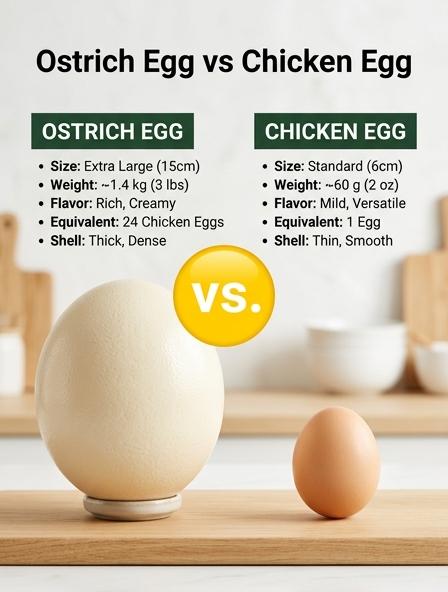
Deciding between ostrich and chicken eggs depends on your desired scale and culinary richness. While the standard chicken egg is a convenient pantry staple, a single ostrich egg is a powerhouse equivalent to roughly twenty-four chicken eggs. For family nutrition, ostrich eggs provide a massive concentration of protein and essential vitamins, making them ideal for feeding a large crowd. Regarding baking consistency, their higher yolk-to-white ratio yields an incredibly creamy texture that elevates cakes and custards to gourmet levels. While chicken eggs offer precision for everyday cooking, the ostrich egg excels in culinary yield, making it the ultimate choice for grand, nutrient-dense feasts.
Nutritional Values and Caloric Content for Families
When comparing ostrich and chicken eggs, the most striking difference is the scale. A single ostrich egg is nutritionally equivalent to roughly 24 large chicken eggs, containing approximately 2,000 calories. While both provide high-quality protein and essential amino acids, their micronutrient profiles vary slightly. Chicken eggs are generally higher in Vitamin A and E, whereas ostrich eggs offer more magnesium and iron per serving.
| Nutrient (per 100g) | Chicken Egg | Ostrich Egg |
|---|---|---|
| Protein | 12.6g | 12.2g |
| Fat | 9.5g | 11.7g |
| Iron | 1.2mg | 1.6mg |
For a unique family reunion or a festive holiday breakfast, home cooks love the spectacle of cracking a single ostrich egg to create a massive, fluffy scramble that feeds a dozen people simultaneously.
Influence on Baking Consistency and Structural Texture
Replacing chicken eggs with ostrich eggs significantly alters a recipe's structural integrity. While a single ostrich egg is equivalent to approximately 24 chicken eggs, the functional difference lies in the protein and fat distribution. Ostrich eggs feature a higher yolk-to-white ratio, which introduces more emulsifiers and fats into a batter than standard poultry eggs.
- Density: Ostrich eggs produce a much denser, tighter crumb structure.
- Moisture: The increased lipid content results in a richer, moister mouthfeel.
- Binding: Their massive protein content creates a powerful bond, ideal for heavy bakes.
Because ostrich eggs are less effective at trapping air compared to the lighter whites of chicken eggs, they are less suitable for airy soufflés but excel in heavy pound cakes or custards. You might use an ostrich egg when preparing a giant festive brownie tray, as its intense richness creates a fudgy, decadent texture that chocolate lovers absolutely adore.
Volume and Yield Differences for Family Recipes
When substituting an ostrich egg in traditional family recipes, the primary consideration is the sheer scale of yield. A single ostrich egg is biologically equivalent to approximately 24 large chicken eggs. This massive volume typically produces nearly 1.4 liters of liquid, making it an efficient, albeit large-scale, ingredient for feeding a crowd.
| Egg Type | Quantity Equivalent | Average Liquid Volume |
|---|---|---|
| 1 Ostrich Egg | 24 Chicken Eggs | ~5.5 Cups |
| 1 Chicken Egg | 1 Unit | ~3 Tablespoons |
To use an ostrich egg for standard recipes, you must whisk the entire contents together first to ensure a uniform ratio of yolk to white before measuring it out by the cup. This prevents the rich, creamy texture from becoming inconsistent across different batches of batter.
Imagine hosting a festive Sunday brunch where a single, massive golden omelet becomes the ultimate centerpiece, feeding your entire extended family from a single shell.
Flavor Nuances and Lipid Concentration in Different Shell Sizes
The culinary distinction between ostrich and chicken eggs is rooted in their lipid concentration and yolk-to-white ratios. While chicken eggs are prized for their versatility, ostrich eggs offer a significantly richer, more buttery flavor profile. This intensity is driven by the ostrich egg's higher proportion of yolk, which contains a dense concentration of fats and fat-soluble vitamins compared to the more balanced chicken egg.
- Chicken Egg: Mild, clean flavor with a lighter consistency; perfect for standard baking and delicate leavening.
- Ostrich Egg: Deeply savory, creamy texture due to elevated lipid levels and a massive yolk-to-white volume.
Because of their immense size and distinct richness, food enthusiasts often choose ostrich eggs for hosting extravagant brunch parties where one single egg can create a decadent scrambled feast for ten people.
Storage Requirements and Refrigeration Standards
Maintaining the freshness of eggs depends largely on shell permeability and environmental control. Chicken eggs have relatively thin, porous shells, making them highly susceptible to bacteria like Salmonella. In many regions, they require consistent refrigeration at 40°F (4°C) to maintain safety and quality for three to five weeks.
In contrast, ostrich eggs are equipped with a shell up to two millimeters thick, providing a formidable barrier against moisture loss and microbial entry. This structural density allows them to have a significantly longer shelf life compared to their smaller counterparts.
- Chicken Eggs: Best kept in their original carton in the main body of the refrigerator.
- Ostrich Eggs: Can remain fresh for several months when stored in a cool, stable environment or a large refrigerator.
You might typically rely on a carton of chicken eggs for your weekly meal prep, but if you decide to purchase a singular ostrich egg, its robust shell allows you to store it as a long-term culinary centerpiece for a future special occasion.
Mineral Content and Health Benefits for Households
Comparing the nutritional density of ostrich eggs to chicken eggs reveals significant advantages for health-conscious households. While both are excellent protein sources, ostrich eggs boast higher concentrations of magnesium, iron, and potassium, which are essential for cardiovascular health and muscle function. Conversely, chicken eggs are typically higher in Vitamin B12 and riboflavin.
- Iron: Ostrich eggs provide more iron per serving to combat fatigue.
- Cholesterol: Ostrich eggs contain lower cholesterol levels relative to their massive size.
- Magnesium: Higher levels in ostrich eggs support better sleep and bone density.
For families managing dietary restrictions, the ostrich egg offers a unique ratio of unsaturated fatty acids. Although one ostrich egg is equivalent to approximately 24 chicken eggs, its mineral-rich composition makes it a functional superfood for growing children and active adults alike.
You might find that preparing one giant ostrich egg is the ultimate conversation starter for a festive family brunch, providing a nutrient-dense feast that easily feeds a dozen people.
Heat Conductivity and Preparation Time Variations
The primary difference in cooking ostrich eggs versus chicken eggs lies in their thermal mass and shell thickness. An ostrich eggshell is approximately 2mm thick, acting as a significant insulator that slows heat conductivity to the yolk. While a standard chicken egg reaches a hard-boiled state in about 10 minutes, the massive volume of an ostrich egg-equivalent to roughly 24 chicken eggs-requires a substantially longer duration for heat to penetrate the core.
| Egg Type | Boiling Time (Hard-Boiled) | Shell Thickness |
|---|---|---|
| Chicken Egg | 10–12 minutes | ~0.3 mm |
| Ostrich Egg | 90–120 minutes | ~2.0 mm |
Imagine the look of wonder on your guests' faces when you serve a single, colossal hard-boiled egg as the centerpiece for a shared family brunch.
Environmental Footprint and Sourcing Availability
The environmental impact of egg production varies significantly based on scale and resource efficiency. While chickens are farmed industrially worldwide, ostriches require more land but often benefit from lower-density farming practices that result in less concentrated waste runoff. One ostrich egg is equivalent to approximately 24 chicken eggs, which can consolidate packaging and transport resources for bulk culinary needs.
- Chicken Eggs: Ubiquitous availability, year-round production, and low cost due to established global supply chains.
- Ostrich Eggs: Highly seasonal (typically available only in spring and summer), requiring direct sourcing from specialty farms or boutique grocers.
Because ostrich eggs are harder to find, they are often reserved for special occasions or eco-conscious foodies looking to reduce individual shell waste. Imagine a chef at a high-end farm-to-table gala cracking open a single ostrich egg to create a massive, velvety frittata that feeds an entire table of twenty guests simultaneously.
Viscosity and Aeration in Culinary Applications
The culinary performance of ostrich eggs differs significantly from chicken eggs due to their unique protein concentration and viscosity. Ostrich egg whites are notably thicker and more gelatinous, requiring more mechanical energy to break down the protein bonds during aeration. While chicken eggs whip into a light, airy foam relatively quickly, the ostrich egg produces a much denser, more stable structure when beaten.
- Chicken Eggs: Low viscosity allows for rapid foaming, ideal for delicate meringues.
- Ostrich Eggs: High viscosity results in a rich, creamy texture and superior binding properties.
This structural difference means that while chicken eggs are the go-to for light leavening, the ostrich egg is prized for its ability to create incredibly moist and heavy bakes. High-end pastry chefs often use an ostrich egg when crafting large-scale, multi-tiered sponge cakes to ensure a sturdy yet velvety crumb that holds up perfectly under heavy fondant and decorations.
Practical Logistics and Kitchen Handling Performance
Managing an ostrich egg versus a chicken egg involves vastly different culinary physics. While a chicken egg is easily cracked on a bowl's edge, an ostrich egg requires a hammer or drill due to its thick, porcelain-like shell. In terms of yield, a single ostrich egg is equivalent to approximately 24 large chicken eggs, making it a feat of logistics rather than a quick breakfast staple.
Key logistical differences include:
- Shell Durability: Ostrich shells are 2mm thick and often require tools to open.
- Cooking Time: Hard-boiling an ostrich egg takes between 90 to 120 minutes.
- Storage: One ostrich egg occupies the shelf space of a small melon.
Imagine hosting a festive holiday brunch where you drill open one massive egg to create a giant, show-stopping frittata that feeds the entire neighborhood.
Ostrich Egg vs Chicken Egg source and external links
- The ostrich egg is the largest egg produced by any living bird, often weighing as much as three pounds.
- The chicken egg is a primary source of high-quality protein and is the most commonly consumed bird egg worldwide.