
Instant Yeast vs Fresh Yeast: Are They The Same? Rise Time, Flavor, and Conversion Ratios.
Rise Time and Dough Performance Variations
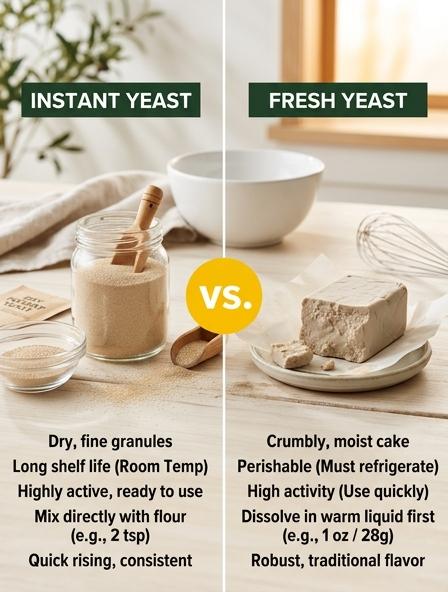
The primary distinction in dough performance lies in activation speed and fermentation stability. Instant yeast is highly concentrated and processed into fine granules, allowing it to bypass the rehydration phase and trigger rapid carbon dioxide production almost immediately. In contrast, fresh yeast (compressed yeast) contains significant moisture and requires dissolving in lukewarm liquid before use, leading to a more gradual and sustained fermentation curve.
| Feature | Instant Yeast | Fresh Yeast |
|---|---|---|
| First Rise | Accelerated/Rapid | Steady/Moderate |
| Dough Type | Lean/Standard | Enriched/High-fat |
While home bakers appreciate the reliable speed of instant yeast for a quick weeknight loaf, professional pastry chefs often prefer the steady lift of fresh yeast for complex brioche to achieve a superior depth of flavor and a delicate, uniform crumb.
Flavor Profiles and Aromatic Differences in Baking
The choice between instant and fresh yeast significantly impacts the sensory outcome of your bread. Fresh yeast, favored by traditionalists, contains higher moisture levels, yielding a rich, "yeasty" aroma and a subtle sweetness often associated with artisanal bakeries. Because it typically requires a slower fermentation process, it allows more time for complex organic compounds to develop, enhancing the depth of the crust and crumb.
- Fresh Yeast: Delivers earthy, slightly fruity undertones and a robust, old-world bready scent.
- Instant Yeast: Provides a clean, neutral profile, focusing on structural rise rather than intense flavor development.
While instant yeast offers unmatched convenience and a reliable lift for everyday sandwich loaves, it often lacks the pungent fragrance found in cake yeast. You will appreciate the aromatic complexity of fresh yeast most when preparing a slow-risen brioche or a traditional holiday panettone where the fermentation scent is a key part of the culinary experience.
Storage Stability and Longevity of Leavening Agents
Understanding the shelf life of leavening agents is essential for consistent baking results. Instant yeast is engineered for stability; its low moisture content allows it to remain viable for up to two years when sealed. Once opened, it stays active for several months if stored in the freezer. In contrast, fresh yeast (or cake yeast) is highly perishable because of its high water content, requiring constant refrigeration to prevent spoilage and loss of potency.
| Yeast Type | Average Shelf Life | Ideal Storage |
|---|---|---|
| Instant Yeast | 1–2 Years (Unopened) | Cool, dry pantry |
| Fresh Yeast | 1–3 Weeks | Refrigerator (35°F - 40°F) |
You might find instant yeast most convenient for occasional home baking, whereas a dedicated artisan baker might choose fresh yeast for its superior activity in high-volume daily recipes.
Crumb Structure and Texture Results in Bread
The choice between instant and fresh yeast significantly alters a loaf's internal architecture. Instant yeast, characterized by its concentrated granules, generally produces a consistent, uniform crumb structure with smaller, regular air cells. This results in a reliable, soft texture ideal for sandwich loaves. In contrast, fresh yeast-often preferred by artisanal bakers-yields a more complex, open crumb. Its high moisture content and steady fermentation contribute to a moister interior and a characteristic "chewy" bite.
| Yeast Type | Crumb Result | Texture Profile |
|---|---|---|
| Instant | Uniform & Fine | Soft & Consistent |
| Fresh | Open & Irregular | Moist & Artisanal |
You will appreciate the delicate, airy pockets and professional-grade crust that fresh yeast provides when crafting a traditional French baguette for a dinner party.
Digestive Health and Nutritional Impact of Fermentation
Fermentation is the vital biological process where both instant and fresh yeast transform simple dough into a nutrient-dense food. During this stage, yeast enzymes break down complex starches and neutralize phytic acid, an anti-nutrient that typically inhibits the absorption of essential minerals like iron, zinc, and magnesium.
- Enhanced Bioavailability: Reduces anti-nutrients to improve mineral uptake.
- Improved Digestibility: Predigests gluten proteins and starches, making the final bread gentler on the gut.
- Vitamin Enrichment: Increases the concentration of B-vitamins through metabolic activity.
While fresh yeast is often celebrated for its high enzymatic activity, instant yeast provides a reliable, rapid fermentation that still achieves significant nutritional gains. Many home bakers prefer using a slow-fermented fresh yeast sponge to develop that signature airy crumb and complex flavor that remains incredibly easy on the stomach, even for those with mild grain sensitivities.
Temperature Tolerance and Activation Methods
Understanding the thermal boundaries of yeast is crucial for a successful rise. Instant yeast is engineered for convenience, boasting a high temperature tolerance that allows it to be mixed directly with dry ingredients; it typically activates most effectively when liquids are between 120°F and 130°F. In contrast, fresh yeast is a living, high-moisture product that is far more sensitive to heat.
- Instant Yeast: Requires no pre-hydration and survives higher processing temperatures.
- Fresh Yeast: Must be crumbled into lukewarm liquid (90°F–95°F) to "bloom" before mixing.
Exceeding 115°F with fresh yeast will likely kill the cultures, resulting in a failed ferment. You might prefer the shelf-stable reliability of instant yeast for a quick weekday loaf, while professional pastry chefs often choose fresh yeast for the superior depth of flavor it brings to slow-fermented danishes and brioche.
Fermentation Consistency in Sweet and Savory Recipes
Achieving a uniform rise depends on the stability of the leavening agent. Instant yeast is engineered for predictability, offering a concentrated cell count that ensures rapid carbon dioxide production across various dough environments. In contrast, fresh yeast (cake yeast) contains roughly 70% moisture, requiring strict refrigeration and precise handling to maintain its fermentative potency.
- Instant Yeast: Highly stable and reliable for high-sugar doughs where osmotic pressure can often inhibit yeast activity.
- Fresh Yeast: Favored for lean, savory doughs due to its immediate activation and ability to provide a nuanced, floral flavor profile.
Imagine a professional baker reaching for fresh cake yeast to achieve that signature sourdough-like depth in a crusty morning baguette, while home enthusiasts prefer the fail-proof rise of instant yeast for a buttery weekend brioche.
Impact on Crust Development and Finishing Color
The choice between instant and fresh yeast significantly influences the Maillard reaction. While both leaven dough effectively, their distinct enzymatic profiles dictate how residual sugars caramelize during the bake.
- Fresh Yeast: Contains active cultures that often lead to a deeper, more vibrant golden-brown crust due to higher maltase activity and sugar conversion rates.
- Instant Yeast: Known for consistency; however, it may result in a slightly paler finish if the fermentation window is too short to develop enough residual sugars for browning.
Fresh yeast generally contributes to a thinner, more aromatic crust, whereas instant yeast provides a reliable, sturdy structure ideal for high-speed production. The metabolic byproducts of fresh yeast enhance browning even at standard domestic oven temperatures.
Artisanal bakers often prefer fresh yeast for sourdough-style boules to achieve that sought-after, deep mahogany finish and a crust that crackles beautifully when squeezed.
Weight and Volume Conversion Ratios for Accuracy
Achieving the perfect fermentation depends on using the correct conversion ratios between fresh and instant yeast. Because fresh yeast contains high moisture and instant yeast is a potent, dry concentrate, they are not interchangeable in equal amounts. To maintain recipe integrity, bakers typically follow a 3:1 weight ratio.
| Yeast Type | Weight Ratio | Example Amount |
|---|---|---|
| Fresh Yeast | 3 | 30g |
| Instant Yeast | 1 | 10g |
To convert accurately, divide the required fresh yeast weight by three. While volume measurements are common-one teaspoon of instant yeast roughly replaces a 15-gram block of fresh yeast-using a digital scale ensures a more consistent crumb structure and predictable rise times.
Home bakers love this simple math because it allows them to adapt traditional artisan bread recipes using the convenient instant packets found in their pantry.
Cost Analysis and Practicality for Home Bakers
Deciding between instant and fresh yeast requires balancing unit price against shelf-life efficiency. While fresh yeast (cake yeast) is often cheaper per ounce, its two-week expiration window frequently leads to waste for those who do not bake daily. Conversely, instant yeast offers superior long-term value because it remains viable for months in the refrigerator or years in the freezer.
- Instant Yeast: High concentration, no refrigeration required until opened, and can be mixed directly into flour.
- Fresh Yeast: Low concentration, requires constant refrigeration, and must be proofed in warm liquid before use.
From a practical standpoint, instant yeast is the gold standard for modern kitchens; many home bakers prefer it because they can spontaneously whip up a batch of cinnamon rolls on a Sunday morning using a vacuum-sealed pack that has been tucked away in the pantry for months.
Instant Yeast vs Fresh Yeast source and external links
- Instant yeast is a fast-acting dry yeast that can be mixed directly into dry ingredients without the need for proofing in liquid. Learn more about the benefits of using instant yeast in your bread recipes.
- Fresh yeast, also known as cake yeast, is a moist and highly perishable leavening agent preferred by many professional bakers for its rich flavor. Read about the proper storage and usage of fresh yeast to ensure successful baking.