
Granulated Sugar vs Powdered Sugar : Which is Best for Baking Texture, Aeration, and Frosting Stability?
Impact of Crystal Size on Cake Crumb and Texture
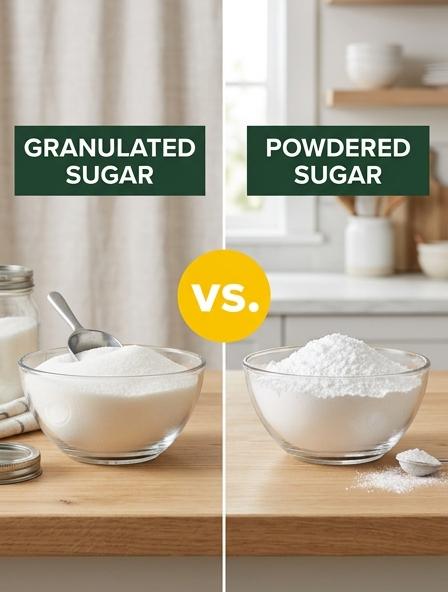
Crystal size is the primary architect of a cake's internal structure. Granulated sugar consists of sharp, coarse crystals that perform a mechanical function during the creaming process. These jagged edges cut through solid fats, trapping air to create tiny bubbles that expand during baking, resulting in a light, airy crumb. In contrast, powdered sugar is pulverized into a fine dust and often contains cornstarch. It lacks the abrasive quality required for aeration and dissolves almost instantly into the batter's moisture.
- Granulated Sugar: Encourages aeration, leading to high volume and a traditional sponge.
- Powdered Sugar: Minimizes air pockets, resulting in a dense, silky, and "short" texture.
You might prefer the structural lift of granulated sugar for a fluffy birthday cake, whereas powdered sugar is the go-to choice when you want a tender, melt-in-your-mouth shortbread cookie.
Structural Integrity and Spread in Cookie Dough
The choice between granulated and powdered sugar fundamentally alters a cookie's physical profile. Granulated sugar consists of sharp crystals that facilitate aeration during the creaming process, creating air pockets that expand and cause the dough to spread. This results in a classic thin, crisp, and chewy texture.
Powdered sugar contains finely ground sucrose mixed with cornstarch. This starch acts as a stabilizer by absorbing moisture, which increases dough viscosity and significantly reduces spread. This creates a dense, "short" crumb often found in meltaway textures.
| Sugar Type | Spread Level | Structural Result |
|---|---|---|
| Granulated | High | Crisp and Porous |
| Powdered | Low | Soft and Uniform |
You might prefer using powdered sugar when baking delicate holiday tea cakes where maintaining a precise, stamped shape is more important than achieving a wide, caramelized crunch.
Effects of Starch Content on Sauce Thickening
The fundamental difference between granulated and powdered sugar in culinary applications stems from the presence of anti-caking agents. While granulated sugar is pure sucrose, commercial powdered sugar typically contains 3% to 5% cornstarch. This starch content acts as a functional stabilizer and thickening agent when exposed to heat and moisture.
- Granulated Sugar: Dissolves into a thin, translucent syrup; provides sweetness without altering the liquid's viscosity.
- Powdered Sugar: Facilitates starch gelatinization, resulting in a creamier, more opaque consistency in sauces and glazes.
Because of these properties, substituting one for the other can significantly alter the texture of a reduction or syrup. Home bakers often prefer whisking powdered sugar into a simple vanilla glaze to achieve that signature thick, white drip that sets perfectly on warm cinnamon rolls.
Solubility Rates in Various Liquid Temperatures
The solubility of sugar is determined by particle surface area and kinetic energy. Granulated sugar consists of larger sucrose crystals, which require significant agitation and time to dissolve, especially in cold liquids. In contrast, powdered sugar is mechanically ground into a fine dust, providing a massive surface area-to-volume ratio that allows for near-instantaneous integration.
Temperature acts as a primary catalyst in this chemical process. As liquid heat increases, water molecules move faster, breaking the intermolecular bonds of the sugar more efficiently. While granulated sugar struggles in iced drinks, it dissolves quickly in boiling water.
| Sugar Type | Cold Solubility | Hot Solubility |
|---|---|---|
| Granulated | Low (Sedimentary) | High |
| Powdered | Moderate to High | Instant |
You will find powdered sugar indispensable when whisking a delicate cold glaze or whipped cream to ensure a silky-smooth texture without the gritty residue of undissolved crystals.
Comparative Caloric Density and Nutritional Values
While granulated and powdered sugar both originate from sucrose, their nutritional profiles diverge slightly due to processing. Granulated sugar is pure sucrose, whereas powdered sugar is finely milled and typically blended with 3% to 5% cornstarch to prevent clumping.
Nutritionally, they are nearly identical by weight, but their caloric density varies significantly by volume. Because powdered sugar is much finer, it packs differently; one cup of granulated sugar weighs significantly more and contains more calories than one cup of the aerated, powdered alternative.
| Nutrient (per 100g) | Granulated Sugar | Powdered Sugar |
|---|---|---|
| Calories | 387 kcal | 389 kcal |
| Carbohydrates | 100g | 99.8g |
You might choose granulated sugar for the necessary structural crunch in a classic sugar cookie, while opting for the cornstarch-enriched powdered variety to ensure your buttercream frosting remains stiff and smooth.
Aeration Performance During the Creaming Stage
The physical structure of sugar dictates how much air can be incorporated into a batter. Granulated sugar features sharp, jagged crystals that act as mechanical leaveners. When creamed with fat, these edges "cut" into the butter, creating millions of microscopic air pockets that expand during baking to provide lift and volume.
- Granulated Sugar: Its coarse texture ensures maximum aeration, resulting in a light, fluffy crumb.
- Powdered Sugar: The fine particles dissolve too quickly and lack the abrasive force needed to trap air, leading to a denser result.
Because powdered sugar often contains cornstarch, it can also alter the protein structure of the dough, further reducing the potential for a high rise. You will likely choose granulated sugar when whisking up a tall, airy sponge cake for a birthday celebration to ensure the texture remains light rather than heavy.
Surface Browning and Caramelization Reactions
Granulated sugar is the primary driver of the Maillard reaction and caramelization in baking. Its pure sucrose crystals melt and break down at high temperatures, creating the complex flavors and deep golden hues characteristic of traditional baked goods. Conversely, powdered sugar contains roughly 3% to 5% cornstarch as an anti-caking agent. This starch can interfere with the chemical breakdown of sugar, often resulting in a paler, softer surface rather than a crisp, browned crust.
- Granulated Sugar: Promotes intense caramelization and provides a distinct crunch.
- Powdered Sugar: Results in a matte finish and less structural browning due to starch content.
Professional bakers prefer granulated sugar when crafting a crème brûlée to ensure that iconic, shatteringly crisp caramelized lid that people love to crack with a spoon.
Humidity Absorption and Long Term Storage
The structural differences between granulated and powdered sugar significantly impact their shelf life and reaction to humidity. Granulated sugar consists of large, stable crystals with a low surface-area-to-volume ratio, making it naturally resistant to moisture-induced clumping. In contrast, powdered sugar is highly hygroscopic. Because the crystals are ground into a fine dust, the increased surface area attracts atmospheric moisture rapidly, often leading to solid blocks despite the addition of anti-caking agents like cornstarch.
To ensure long-term usability, consider these storage requirements:
- Granulated Sugar: Remains shelf-stable indefinitely in a cool, dry pantry.
- Powdered Sugar: Must be kept in an airtight container or vacuum-sealed bag to prevent hardening.
Professional bakers always sift their powdered sugar through a fine-mesh strainer to remove the stubborn lumps that form whenever humidity levels rise in the kitchen.
Measurement Precision Between Coarse and Fine Textures
Achieving consistency in baking requires understanding the density differences between granulated and powdered sugar. Granulated sugar consists of uniform, coarse crystals that settle predictably with minimal air gaps. In contrast, powdered sugar is mechanically ground into a fine dust and often mixed with cornstarch, making it highly susceptible to aeration and compression.
- Granulated Sugar: Its structural integrity allows for a relatively stable volume-to-weight ratio, usually weighing about 200g per cup.
- Powdered Sugar: The fine texture traps air; a "sifted" cup can weigh significantly less than a "packed" cup, leading to measurement errors.
Because fine particles fill voids more efficiently than coarse ones, measuring by volume can cause a 20% variance in actual sugar content. Professional bakers mitigate this by using metric scales to ensure the precise sweetness and chemical balance of their recipes.
You will notice a world of difference in your macaron shells when you switch from measuring by cups to using a digital scale for your powdered sugar.
Texture Stability in Glazes and Frostings
The primary difference in stability between granulated and powdered sugar lies in particle size and additives. Granulated sugar features large sucrose crystals that provide structure in baked goods but often remain gritty in cold applications like buttercream. Powdered sugar is mechanically ground into a fine powder and typically contains 3% to 5% cornstarch. This starch acts as an anti-caking agent and stabilizer, preventing the sugar from clumping and helping glazes maintain a consistent viscosity.
- Solubility: Powdered sugar dissolves instantly in room-temperature liquids, ensuring a smooth mouthfeel.
- Thickening: The cornstarch in powdered sugar absorbs excess moisture, preventing frostings from "weeping."
- Structure: Granulated sugar requires high-heat syruping or extensive whipping to achieve stability in frostings like Swiss Meringue.
You will find that powdered sugar is the superior choice when whisking a simple donut glaze to ensure it sets with a crackly, professional-grade sheen rather than a grainy residue.
Granulated Sugar vs Powdered Sugar source and external links
- Commonly used in everyday baking and cooking, granulated sugar is a highly refined multipurpose sweetener with a gritty texture.
- Also known as confectioners' sugar, powdered sugar is finely ground granulated sugar mixed with an anti-caking agent to create a smooth consistency for frostings and glazes.