
Cassava Flour vs Starch: Which is Best for Gluten-Free Baking, Sauce Thickening, and Nutrient Density?
Nutrient Density and Fiber Content in Whole Root Powders
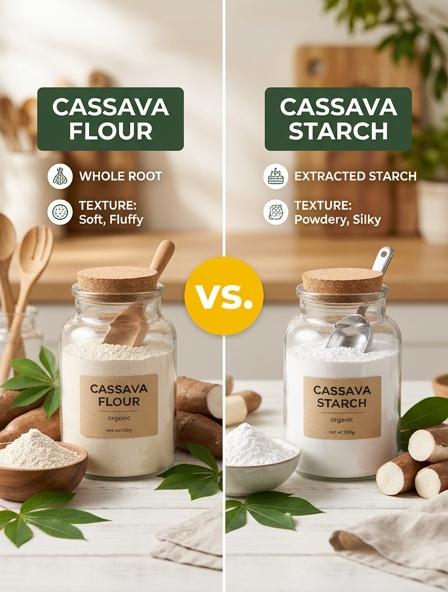
The nutritional profile of cassava flour is vastly superior to its starch counterpart because it utilizes the entire root. While cassava starch is an isolated carbohydrate, the whole root powder undergoes minimal processing, preserving essential components often lost during extraction.
- Dietary Fiber: Flour retains the plant's natural cell walls, supporting digestive health.
- Micronutrients: It contains trace amounts of calcium, vitamin C, and potassium.
- Resistant Starch: High-quality whole root powders provide prebiotic benefits that fuel beneficial gut bacteria.
In contrast, cassava starch (tapioca) is stripped of these elements to create a pure thickening agent. Because the flour includes the fibrous pulp, it offers a more balanced glycemic response and a denser nutrient profile than refined alternatives.
You will appreciate using whole cassava flour when crafting homemade grain-free tortillas, as the extra fiber provides the perfect "stretch" and a more satisfying, nutritious bite that health-conscious eaters love.
Texture Variations from Binding Strength to Elasticity
The functional differences between cassava flour and starch are most evident in the final mouthfeel of a dish. Cassava flour, produced from the entire root, retains dietary fiber which contributes to a robust binding strength and a more substantial, dense crumb. Conversely, cassava starch-often labeled as tapioca-is isolated from the root's milky liquid, resulting in a product that prioritizes elasticity and a characteristic "springy" texture.
- Cassava Flour: Best for providing structure and a soft, cake-like consistency in gluten-free baking.
- Cassava Starch: Ideal for achieving a chewy, translucent finish and adding a light crunch to fried coatings.
Home bakers love using the starch to create the signature gooey stretch in Brazilian Pão de Queijo, whereas they turn to the flour for a hearty, grain-free sandwich loaf.
Visual Differences between Opaque Finishes and Translucency
The primary visual distinction between cassava flour and starch lies in how they react to moisture and heat. Cassava flour, produced from the entire root, retains fiber and proteins that create a matte, opaque finish. In contrast, cassava starch (tapioca) consists of pure extracted starch, which undergoes gelatinization to produce a clear, translucent appearance.
- Cassava Flour: Results in a dense, solid look similar to traditional wheat flour.
- Cassava Starch: Becomes a shimmering, see-through gel when thickened.
These optical properties determine the aesthetic of the final dish. While the flour provides the sturdy, non-reflective crumb required for rustic artisan breads, home bakers love using the starch to achieve the jewel-like clarity and high-gloss sheen found in professional fruit pie fillings.
Digestive Benefits of Whole Fiber versus Purified Extracts
Understanding the distinction between cassava flour and starch is essential for gut health. Cassava flour is a whole-food ingredient, meaning it retains the natural dietary fiber found in the root. This fiber acts as a prebiotic, fueling beneficial gut bacteria and promoting regular bowel movements. In contrast, cassava starch is a refined extract, providing pure carbohydrates without the fibrous matrix.
- Cassava Flour: Contains insoluble fiber that aids digestion and slows glucose absorption.
- Cassava Starch: A purified polysaccharide used primarily for its thickening properties and rapid energy release.
While starch is excellent for creating smooth textures, the whole fiber in flour supports a more stable glycemic response and long-term satiety. You will appreciate the difference when baking hearty grain-free bread that keeps you feeling satisfied and energized throughout a busy afternoon.
Viscosity Stability in High Temperature Cooking
The primary difference between cassava flour and starch during thermal processing lies in their molecular composition. Cassava starch consists of pure amylopectin and amylose, leading to a high peak viscosity that can quickly "break down" or thin out under prolonged high heat or shear. Conversely, cassava flour retains its natural fiber and protein content, which act as structural buffers.
- Cassava Starch: Rapid thickening with a clear finish, but prone to thinning if over-boiled.
- Cassava Flour: More resistant to viscosity loss, providing a stable, opaque thickness throughout extended cooking times.
Because the non-starch components in the flour help regulate water absorption, it maintains a more consistent mouthfeel in demanding culinary environments. You will prefer using cassava flour when simmering a hearty beef stew for hours, ensuring the sauce stays thick and velvety rather than turning watery before it hits the table.
Crumb Structure and Moisture Retention in Baked Goods
The choice between cassava flour and starch significantly impacts the final texture and shelf-life of gluten-free bakes. Cassava flour, a whole-root product, contains fiber that excels at moisture retention, creating a dense, soft, and bread-like crumb. Conversely, cassava starch (tapioca) focuses on gelatinization, providing the elasticity and "spring" necessary for lighter, airier results.
- Cassava Flour: High water absorption leads to a moist, tight crumb structure suitable for pound cakes and artisan loaves.
- Cassava Starch: Enhances crispness and creates a chewy, stretchy interior often found in Brazilian cheese bread.
Balancing these two ensures a cohesive structure; starch prevents grittiness while flour provides the structural bulk needed to mimic traditional wheat-based recipes. Imagine pulling a fresh tray of gluten-free muffins from the oven, where the cassava flour provides a rich, fudgy crumb that remains incredibly tender long after cooling.
Flavor Intensity from Earthy Notes to Neutral Profiles
The primary sensory difference between cassava flour and starch lies in how the root is processed. Cassava flour is a whole-food product made by grating and drying the entire tuber, which preserves its complex, slightly nutty, and earthy essence. In contrast, cassava starch-frequently labeled as tapioca-is a refined extract that undergoes a washing and pulping process to isolate the carbohydrates while removing fiber.
- Cassava Flour: Retains a distinct, rustic aroma and characteristic "whole grain" tang.
- Cassava Starch: Offers a completely neutral palette that remains invisible to the taste buds.
You may find that the robust profile of cassava flour adds wonderful depth to homemade grain-free tortillas, while the flavorless nature of the starch is exactly what you need to thicken a delicate lemon curd without altering its bright acidity.
Metabolic Response to Complex Solids versus Pure Carbohydrates
The metabolic impact of cassava products depends heavily on their structural complexity. Cassava flour is a "whole food" ingredient, meaning it retains the root's fibrous matrix, minerals, and small amounts of protein. These complex solids act as a physical barrier, slowing down gastric emptying and the enzymatic breakdown of starches into glucose.
In contrast, cassava starch (tapioca) is a refined isolate. Without fiber to act as a metabolic speed bump, it is rapidly hydrolyzed, leading to a more pronounced glycemic response. The primary differences in bodily processing include:
- Absorption Speed: Flour offers a steady energy release; starch provides a rapid glucose spike.
- Satiety Levels: The dietary fiber in flour promotes the release of fullness hormones.
- Insulin Sensitivity: Complex solids require less immediate insulin compared to pure carbohydrate isolates.
Health-conscious bakers often choose whole cassava flour over isolated starch when making grain-free pancakes to ensure their family stays full and focused until lunchtime without an energy crash.
Dough Consistency and Handling Properties for Home Kitchens
In home baking, the choice between cassava flour and starch fundamentally alters dough behavior. Cassava flour, derived from the whole root, contains fiber that provides structural integrity and a malleable quality similar to wheat. It absorbs more liquid, resulting in a dough that is easier to knead and shape without excessive sticking. Cassava starch (tapioca starch), however, is pure carbohydrate. It creates a high-viscosity, elastic consistency that becomes translucent and "glue-like" when hydrated and heated.
- Cassava Flour: Offers high stability and a dry touch; ideal for rolling out flatbreads or forming sturdy loaves.
- Cassava Starch: Provides superior elasticity and a chewy mouthfeel; essential for binders and soft textures.
You will find that cassava flour is your go-to for a rustic pizza crust that holds its shape, while the starch is the secret ingredient you need for achieving that signature soft, stretchy pull in homemade gluten-free crepes.
Clarity and Shine in Sauce Thickening Applications
The visual outcome of a recipe depends significantly on the choice between cassava flour and starch. Cassava starch, which is the isolated carbohydrate of the root, gelatinizes into a completely transparent, high-gloss finish. Because it lacks the fibrous components of the whole root, it provides a clean, neutral base that allows the colors of your ingredients to pop.
In contrast, cassava flour includes the entire root's fiber and protein, leading to an opaque and matte appearance. The differences are best summarized by their physical properties after heating:
- Cassava Starch: Clear, shimmering, and smooth texture.
- Cassava Flour: Cloudy, opaque, and a more rustic, thick consistency.
Home cooks typically prefer cassava starch when crafting a vibrant, shimmering fruit glaze for tarts where a crystal-clear, professional-grade shine is essential.
Cassava Flour vs Starch source and external links
- Cassava flour is a grain-free, gluten-free alternative produced by peeling, drying, and grinding the entire cassava root. Cassava Flour
- Starch is a complex carbohydrate found in various plants that serves as a vital energy source and a common thickening agent in cooking. Starch