
Brown Sugar vs Jaggery : Are They The Same? Nutritional Value, Baking Performance, and Glycemic Index
Nutritional Content and Dietary Value for Daily Consumption
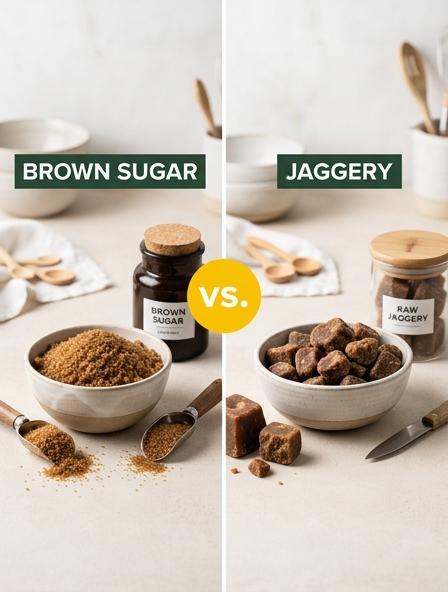
While both sweeteners primarily consist of sucrose, their nutritional profiles differ significantly due to processing methods. Jaggery is an unrefined sugar produced through traditional evaporation, allowing it to retain essential micronutrients. Conversely, brown sugar is typically refined white sugar with a small amount of molasses added back, offering fewer health benefits.
- Jaggery: Contains vital minerals like iron, magnesium, and potassium, and is often used in traditional medicine to aid digestion.
- Brown Sugar: Provides a moist texture and deep flavor but lacks the significant antioxidant properties found in unrefined counterparts.
In terms of daily consumption, both are high-calorie carbohydrates and should be used in moderation. However, jaggery has a slightly more complex chemical structure, which may result in a marginally slower metabolic release compared to refined sugars. Health-conscious tea drinkers often stir a small piece of organic jaggery into their morning chai, valuing its earthy depth and mineral content over the simple sweetness of processed sugar.
Moisture Levels and Their Effect on Cake Texture
The primary difference between brown sugar and jaggery lies in their hygroscopic properties-their ability to attract and hold water. Brown sugar consists of refined sucrose with a specific coating of molasses, ensuring a predictable, soft crumb and consistent moisture retention. Conversely, jaggery is an unrefined non-centrifugal sugar that retains high levels of natural moisture and minerals, which can significantly alter the structural integrity of a bake.
- Brown Sugar: Produces a light, elastic crumb with a subtle caramel lift.
- Jaggery: Results in a denser, fudgier consistency and a deeper, earthy flavor profile.
Because jaggery is more moisture-heavy and acidic, it reacts uniquely with leavening agents, often yielding a tighter crumb than standard brown sugar. You might find jaggery the superior choice when baking a rich, spiced carrot cake where a dense, melt-in-the-mouth texture is highly desired by your guests.
Flavor Depth and Aroma in Traditional Dessert Recipes
Choosing between brown sugar and jaggery significantly impacts the sensory profile of a dish. Brown sugar, typically a mixture of refined white sugar and molasses, offers a predictable, buttery sweetness with mild caramel undertones. In contrast, jaggery is unrefined and retains a rustic, complex bouquet. Because it is produced without removing the molasses and crystals, its flavor can range from earthy and smoky to fruity or even slightly salty.
- Brown Sugar: Delivers a clean, consistent molasses fragrance and high moisture content.
- Jaggery: Provides an intense, mineral-rich depth that anchors traditional Asian and African confections.
The aromatic differences are most noticeable when heat is applied, as jaggery releases a pungent, fudge-like scent that refined sugars lack. You might prefer the deep, wine-like richness of jaggery when crafting an authentic coconut-based dessert, while choosing brown sugar for that classic, soft-baked texture in a batch of chocolate chip cookies.
Mineral Density and Vitamin Retention for Family Wellness
When comparing sweeteners for family wellness, the nutritional gap between brown sugar and jaggery is significant. Brown sugar is typically refined white sugar with a small amount of molasses added back for color and flavor. In contrast, jaggery is unrefined, meaning it retains the natural mineral density found in sugarcane juice. This preservation makes jaggery a superior source of micronutrients that are often stripped away during industrial sugar processing.
- Iron: Essential for preventing anemia and boosting energy levels.
- Magnesium: Supports bone health and relaxes the nervous system.
- Potassium: Helps maintain electrolyte balance and heart health.
- Antioxidants: Jaggery contains phenolic compounds that help combat oxidative stress.
Because jaggery undergoes minimal processing, it provides a slow-release energy source compared to the quick spikes caused by brown sugar. Many health-conscious parents now prefer stirring a piece of organic jaggery into their child's warm milk or morning porridge as a nutrient-rich alternative to processed crystals.
Caramelization Temperatures and Heat Performance in Baking
The thermal behavior of brown sugar and jaggery differs significantly due to their chemical compositions. Brown sugar, a blend of refined sucrose and molasses, begins to caramelize predictably at approximately 320°F (160°C). In contrast, jaggery is unrefined and contains high levels of invert sugars and minerals, which lower its burning point. It often begins to undergo chemical changes and browning at temperatures as low as 250°F.
- Brown Sugar: Offers consistent heat stability and predictable spread in cookies.
- Jaggery: Provides rapid browning and a deeper, earthy aroma but requires careful temperature monitoring to avoid bitterness.
Because jaggery is more hygroscopic and heat-sensitive than brown sugar, it reacts uniquely with leavening agents and fats during the creaming process. You will find that using jaggery in slow-baked fruitcakes results in a rich, fudgy density and a complex smoky sweetness that standard refined sugars cannot achieve.
Dissolution Rates in Coffee and Tea Applications
The solubility of these sweeteners depends heavily on their processing and moisture content. Brown sugar, essentially refined sucrose with a molasses coating, features fine crystals that dissolve almost instantly in hot liquids. Conversely, jaggery is an unrefined sweetener with a dense molecular structure and higher mineral content, leading to a significantly slower dissolution rate.
- Brown Sugar: Rapidly integrates; provides consistent sweetness with minimal stirring.
- Jaggery: Requires higher temperatures or mechanical agitation (stirring) to break down its complex fibers and solids.
While brown sugar offers convenience, jaggery's slower melt often results in a unique sediment that adds body to traditional brews. You might prefer the quick-dissolving ease of brown sugar for your fast-paced morning coffee, whereas the rich, lingering sweetness of hand-crumbled jaggery is a favorite for those who savor a slow-simmered spiced chai.
Glycemic Index and Blood Glucose Management
Understanding the Glycemic Index (GI) is essential for managing blood sugar spikes when choosing between brown sugar and jaggery. Both sweeteners are high-carbohydrate energy sources, but their metabolic impact differs based on processing and chemical composition.
| Sweetener | Glycemic Index (GI) | Metabolic Impact |
|---|---|---|
| Brown Sugar | Approximately 64 | Moderate to High |
| Jaggery | Approximately 84 | High |
While jaggery is often perceived as healthier due to its mineral content, it actually possesses a higher GI than refined brown sugar, leading to faster glucose absorption. Neither is considered a low-glycemic food; therefore, individuals monitoring insulin sensitivity should treat both as high-impact sugars. You might prefer jaggery for its earthy richness in a traditional dessert, but always monitor your portions to prevent the energy crashes that follow a rapid blood sugar spike.
Production Methods and Purity Levels in Food Processing
The primary difference between brown sugar and jaggery lies in their processing intensity. Brown sugar is generally a refined product made by coating white sugar crystals with molasses or through partial centrifugation. This industrial process ensures a uniform color and texture but removes most natural minerals found in the original cane juice.
Jaggery, conversely, is an unrefined sweetener produced by boiling raw sugarcane juice or palm sap in large vessels until it thickens and cools into a solid block. Because it bypasses the centrifugation and bleaching stages common in commercial sugar mills, it retains its purity and natural nutrient profile.
- Brown Sugar: Highly processed, refined crystals, consistent moisture.
- Jaggery: Traditional, non-centrifuged, mineral-rich.
Home cooks often prefer stirring a spoonful of crumbled jaggery into their morning masala chai or artisan bread dough for a deep, caramel-like complexity that refined brown sugar simply cannot replicate.
Shelf Life and Hardening During Pantry Storage
Both brown sugar and jaggery possess long shelf lives, yet they react differently to pantry environments. Brown sugar contains molasses, which provides essential moisture. When exposed to air, this moisture evaporates, causing the sugar crystals to glue together into a rock-hard mass. Conversely, jaggery is more stable but remains highly sensitive to humidity. In damp conditions, jaggery can become sticky or lose its structure, while in dry air, it becomes extremely dense and difficult to carve.
- Brown Sugar: Best used within six months for optimal texture, though it remains safe to consume indefinitely.
- Jaggery: Maintains its nutritional profile for years if kept in a cool, airtight container away from moisture.
You might enjoy the nostalgic ritual of chipping away at a block of hardened jaggery for your traditional desserts, knowing its concentrated sweetness remains potent long after the package was first opened.
Binding Qualities and Consistency in Homemade Sweets
The choice between brown sugar and jaggery fundamentally alters the texture and "hold" of your homemade treats. Brown sugar, a blend of refined sugar and molasses, provides a soft, moist consistency that results in a chewy crumb. In contrast, jaggery is an unrefined sweetener that offers superior binding strength. When melted into a syrup, jaggery becomes highly viscous, acting as a natural edible glue for dense ingredients.
- Brown Sugar: Yields a flexible, soft texture; dissolves quickly for uniform moisture.
- Jaggery: Creates a firm, brittle, or dense structure; ideal for molding solid shapes.
While both provide deep caramel notes, their structural behavior during cooling differs significantly. Brown sugar maintains a degree of granularity, whereas jaggery sets into a solid mass that securely anchors dry inclusions like nuts, seeds, or lentils.
You will find that jaggery is the essential choice for crafting firm traditional peanut chikki that requires a clean snap, while brown sugar remains the favorite for achieving that classic, bendable soft-batch cookie consistency.
Brown Sugar vs Jaggery source and external links
- Brown sugar is a sucrose sugar product that derives its characteristic dark color and moisture from the presence of molasses. Learn more about brown sugar.
- Jaggery is a traditional, unrefined sugar product made from cane juice or palm sap that is popular throughout Asia and Africa. Read more about jaggery.