
Basmati Rice vs White Rice : Are They The Same? Glycemic Index, Nutritional Value, and Texture.
Are you wondering if your favorite fluffy grains are truly interchangeable? While they may look similar on a plate, the debate of Basmati Rice vs White Rice reveals significant differences in health impact and culinary performance. Unlike standard short-grain white rice, Basmati is a long-grain aromatic variety prized for its distinct popcorn-like scent and firm, separate texture that never turns mushy. Nutritionally, Basmati stands out with a lower glycemic index, meaning it causes a slower, more stable rise in blood sugar. While both provide essential carbohydrates, Basmati offers a more complex flavor profile and superior nutritional value for anyone mindful of their glucose levels.
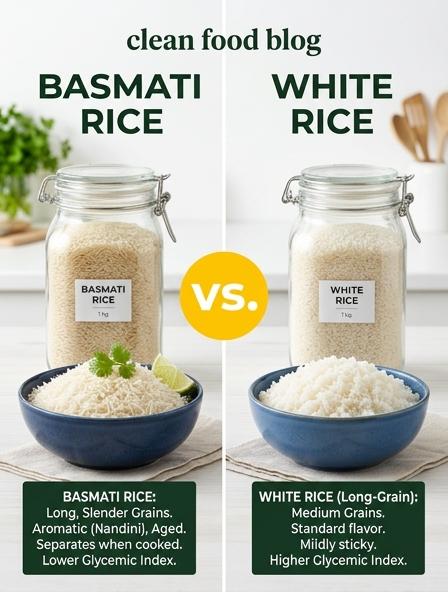
Texture and Grain Separation in Home Cooking
The primary difference between Basmati and standard white rice lies in their starch composition, specifically the ratio of amylose to amylopectin. Basmati rice is naturally high in amylose, which ensures that grains remain firm, individual, and distinct after cooking. This superior "grain separation" prevents the clumping or mushy texture often found in shorter-grain varieties.
In contrast, common long-grain white rice or Jasmine rice contains more amylopectin, resulting in a softer, slightly stickier consistency. This structural difference affects the final plating:
- Basmati: Elongates significantly, staying exceptionally fluffy and dry.
- White Rice: Provides a moist, tender bite with moderate grain adhesion.
You will prefer Basmati when crafting a fragrant saffron pilaf where every grain must remain perfectly separate, whereas standard white rice is the ideal choice for a cozy, saucy chicken curry bowl where you want the rice to soak up the gravy.
Blood Sugar Impact and Glycemic Response
The primary distinction between Basmati and standard white rice lies in their Glycemic Index (GI) scores, which measure how rapidly carbohydrates affect blood glucose levels. Standard short-grain white rice typically carries a high GI, often exceeding 70, leading to rapid insulin spikes and subsequent energy crashes.
- Basmati Rice: Classified as medium GI (typically 50–58), resulting in a slower, more controlled release of energy.
- White Rice: Often classified as high GI (70–89), causing quick fluctuations in blood sugar.
Basmati's lower glycemic response is largely due to its higher amylose content. This type of starch digests more slowly than the amylopectin found in stickier rice varieties. By choosing grains that break down gradually, you maintain more stable metabolic levels and prolonged satiety throughout the day.
You might opt for Basmati rice in your dinner bowl to ensure a steady release of energy that prevents a late-night sugar spike before bed.
Fragrance Profiles and Kitchen Aromas
The most striking difference between Basmati and regular white rice is their olfactory impact. Basmati, translated as "the fragrant one," contains the compound 2-acetyl-1-pyrroline, which gives it a distinctive nutty, popcorn-like scent. While standard white rice offers a neutral, clean aroma that stays in the background, Basmati is prized for its ability to fill a kitchen with an inviting, floral perfume.
- Basmati Rice: Intense, nutty, and aromatic; often compared to sandalwood or warm toast.
- Regular White Rice: Mild and subtle; designed to act as a blank canvas for surrounding flavors.
Many home cooks prefer Basmati for special occasions because of how the steam carries its rich scent throughout the house, making it the perfect aromatic foundation for a slow-cooked, festive saffron biryani.
Starch Concentration and Finished Consistency
The primary difference between Basmati and standard white rice lies in their starch profiles. Basmati is characterized by a high concentration of amylose, a starch molecule that keeps grains firm and separate. Conversely, many varieties of short and medium-grain white rice are higher in amylopectin, which results in a sticky, glutinous texture when cooked.
- Basmati Rice: Features long, slender grains that remain dry, fluffy, and distinct.
- White Rice: Offers a soft, moist consistency where grains tend to clump together.
This chemical makeup dictates the final culinary application. While standard white rice provides a cohesive, tender bite, Basmati is prized for its light, airy mouthfeel and its ability to maintain individual grain integrity even after reheating.
You might choose Basmati when preparing a festive biryani where each grain must remain separate and distinct, whereas you will likely prefer standard white rice for a comforting bowl of sticky rice paired with a saucy stir-fry.
Caloric Content and Weight Management Factors
When comparing Basmati rice to standard white rice, the caloric density is remarkably similar, with both providing approximately 205 to 215 calories per cooked cup. However, the primary differentiator for weight management is the Glycemic Index (GI). Basmati rice typically features a lower GI (50 to 58) compared to short-grain white rice, which often exceeds 70.
| Feature | Basmati Rice | Standard White Rice |
|---|---|---|
| Glycemic Index | Low to Medium | High |
| Digestion Rate | Slow | Rapid |
A lower GI ensures that energy is released gradually into the bloodstream, preventing the sharp insulin spikes that can lead to fat storage and increased hunger. Fitness enthusiasts often prefer fragrant Basmati for their weekly meal prep because its fluffy texture provides a satisfying volume that keeps them feeling full until their next scheduled meal.
Water Absorption and Cooking Performance
The primary difference between Basmati and regular white rice lies in their starch composition and hydration needs. Basmati rice is high in amylose, which prevents the grains from sticking together, allowing them to expand longitudinally up to twice their original length. Standard short or medium-grain white rice contains more amylopectin, resulting in a softer, more cohesive texture once the starch gelatinizes.
- Basmati Rice: Typically requires a 1:2 rice-to-water ratio and benefits from soaking to achieve maximum elongation.
- White Rice: Generally uses a 1:1.5 ratio, cooking faster into a moist, tender consistency that clings together.
Because of these properties, Basmati is the superior choice for pilafs where individual grain definition is key, whereas regular white rice excels in dishes requiring a plush, absorbent base. You will appreciate the way Basmati grains remain light and fluffy for a formal saffron rice dish, while standard white rice provides that familiar, comforting stickiness perfect for soaking up rich gravies.
Fiber Density and Digestive Wellness
When comparing Basmati rice to standard white rice, fiber density plays a crucial role in digestive health. Traditional white rice undergoes extensive milling, which removes the husk, bran, and germ, leaving primarily starch. In contrast, Basmati rice-especially the brown or parboiled varieties-retains more dietary fiber, which aids in regular bowel movements and supports a healthy gut microbiome.
The structural differences impact how your body processes these grains:
- Basmati Rice: Contains higher amylose, leading to slower digestion and a lower glycemic response.
- Generic White Rice: Typically higher in amylopectin, causing quicker spikes in blood sugar and faster hunger recurrence.
Higher fiber intake is generally linked to improved satiety and long-term metabolic wellness. You might prefer the light, airy texture of Basmati for a fragrant biryani that keeps you feeling energized and full throughout the afternoon without the heavy "carb crash" often associated with over-processed short-grain rice.
Flavor Synergy with Main Course Ingredients
The choice between Basmati and standard white rice hinges on the desired interaction with other ingredients. Basmati rice is prized for its aromatic profile, containing the compound 2-acetyl-1-pyrroline, which provides a distinctive nutty, floral fragrance. This makes it an active component that enhances spices. Standard white rice, however, offers a neutral "blank canvas," designed to absorb heavy sauces without competing for flavor dominance.
| Rice Variety | Flavor Profile | Best Culinary Use |
|---|---|---|
| Basmati | Nutty, Floral, Aromatic | Biryanis, Curries, Pilafs |
| White Rice | Neutral, Clean, Sweet | Stir-fries, Gumbo, Casseroles |
Home cooks often prefer the way a rich, buttery garlic sauce seeps between individual, fluffy Basmati grains to create a multi-layered aromatic experience.
Visual Presentation and Plating Styles
The aesthetic appeal of a meal is heavily influenced by the grain's structure. Basmati rice is celebrated for its needle-like elegance; upon cooking, the grains elongate to nearly twice their original size and remain remarkably separate. This creates a fluffy, voluminous texture that looks light and sophisticated on the plate. Conversely, standard white rice-especially medium and short-grain varieties-possesses a rounder profile and higher starch content, resulting in a cohesive, pearly appearance where grains tend to cling together.
- Basmati: Offers a professional, "scattered" look perfect for garnish-heavy dishes.
- White Rice: Provides a dense, uniform canvas that holds heat and structural shapes well.
Imagine hosting a dinner where you spread a fragrant bed of individual Basmati grains beneath a vibrant lamb shank, or contrastingly, use the natural stickiness of white rice to press a perfect, steaming dome alongside a glossy teriyaki glaze.
Vitamin Availability and Mineral Comparisons
When evaluating the nutritional landscape of Basmati rice versus standard white rice, the focus often shifts to micronutrient density. Basmati rice generally offers a slightly superior profile of B-vitamins, including thiamine and niacin, which are vital for supporting energy metabolism and neurological health. While standard white rice is frequently enriched with folic acid and iron to compensate for nutrients lost during processing, Basmati naturally retains a higher concentration of minerals like magnesium and selenium.
- Thiamine (B1): Supports heart and nerve function; typically higher in Basmati.
- Magnesium: Essential for muscle function and bone health.
- Fortification: Standard white rice often relies on synthetic additives for its mineral content.
Fitness enthusiasts often choose fragrant Basmati for their post-workout meal because it provides a cleaner source of natural vitamins while maintaining a lower glycemic index than traditional short-grain white rice.
Basmati Rice vs White Rice source and external links
- Basmati rice is a long-grain, aromatic variety primarily grown in the foothills of the Himalayas and known for its distinct fragrance.
- White rice is a milled grain that has had its husk, bran, and germ removed to improve shelf life and provide a softer texture.