
Active Dry Yeast vs Rapid Rise Yeast: The Differences in Fermentation Speed, Activation Requirements, and Flavor Profiles.
Comparative Fermentation Speeds of Traditional and Instant Leaveners
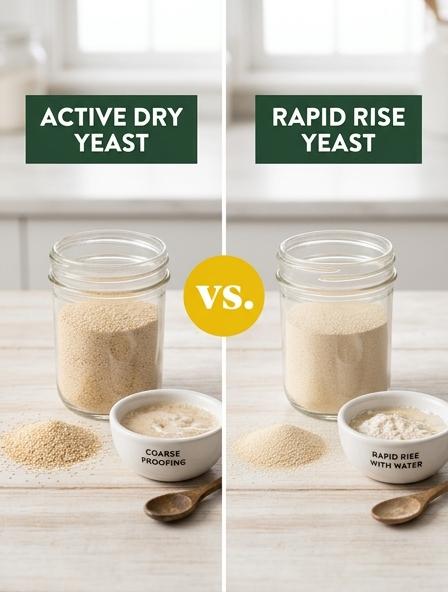
Understanding the kinetic differences between leavening agents is crucial for baking precision. Active dry yeast consists of larger granules that require rehydration in warm water (proofing) to activate dormant cells, leading to a steady, moderate fermentation rate.
- Active Dry Yeast: Requires a 10-minute activation period and typically two separate rises for optimal dough development.
- Rapid Rise Yeast: Formulated with smaller particles and added enzymes to bypass proofing and accelerate carbon dioxide production.
The metabolic speed of rapid rise yeast allows for a single, shortened rise, cutting total preparation time significantly compared to its traditional counterpart. While both produce excellent crumb structures, the slower pace of active dry yeast often allows for more complex flavor development through organic byproduct accumulation.
You can choose rapid rise yeast when you need a quick batch of dinner rolls ready in under an hour for a busy weeknight meal.
Temperature Sensitivity Variations in Common Baking Granules
Understanding thermal limits is essential for successful fermentation. Active dry yeast and rapid rise yeast respond differently to liquid temperatures due to their processing and granule size. Active dry yeast consists of larger, dormant granules that must be "bloomed" in warm water to reactivate. In contrast, rapid rise yeast is finely ground and includes enzymes that accelerate activity, allowing it to withstand higher initial heat.
- Active Dry Yeast: Requires a narrow window of 105°F to 115°F. Temperatures above 120°F can damage or kill the yeast cells.
- Rapid Rise Yeast: Designed for efficiency, it tolerates liquid temperatures between 120°F and 130°F when mixed directly with dry ingredients.
Exceeding these thresholds results in a "dead" dough that fails to expand. Busy home bakers typically reach for rapid rise yeast when making quick weeknight pizza crusts, as it bypasses the proofing stage and halves the rising time.
Impact of Proofing Duration on Homemade Dough Texture
The choice between Active Dry Yeast and Rapid Rise Yeast significantly dictates the fermentation timeline and the final crumb structure of your bread. Active Dry Yeast requires a longer proofing duration, allowing enzymes more time to break down starches. This extended period enhances flavor complexity and creates a more robust gluten network, resulting in an airy, chewy texture.
- Active Dry: Requires blooming; ideal for slow-rise artisanal loaves with deep flavor.
- Rapid Rise: High potency; designed for single-rise recipes and time-sensitive baking.
Conversely, Rapid Rise Yeast accelerates gas production, drastically shortening the wait time. While convenient, the quick expansion often leads to a tighter, more uniform grain. Understanding these timing nuances ensures you achieve the desired density and stretch in every batch of homemade dough.
You might prefer the slow-proof method of Active Dry Yeast when preparing a Friday night pizza crust to achieve those signature charred bubbles and complex, yeasty notes.
Activation Requirements for Standard Versus Fast Acting Varieties
The fundamental difference between these two yeasts lies in their hydration needs. Active Dry Yeast contains larger, dormant granules that must be "proofed" to ensure viability. This process involves dissolving the yeast in warm water (105°F–115°F) with a pinch of sugar until it becomes foamy. Conversely, Rapid Rise Yeast-a type of instant yeast-is milled into finer particles that hydrate much faster.
- Active Dry: Requires blooming in liquid for 5–10 minutes before adding to flour.
- Rapid Rise: Can be mixed directly into dry ingredients, bypassing the proofing stage entirely.
While Rapid Rise yeast cuts down on rising time and preparation, the traditional blooming of Active Dry provides a reliable safety check to ensure your yeast is active before you begin your bake. You will find Rapid Rise indispensable when you need to whip up a quick batch of cinnamon rolls for a last-minute brunch.
Flavor Profile Changes Between Long and Short Fermentation
The primary difference in flavor between active dry and rapid rise yeast stems from the duration of the fermentation window. Active dry yeast necessitates a slower rise, allowing enzymes and natural bacteria time to break down starches into organic acids and aromatic esters. This creates the complex, nutty, and slightly tangy notes prized in artisan baking.
In contrast, rapid rise yeast is optimized for speed and gas production rather than metabolic depth. Because the dough matures quickly, it lacks the secondary chemical reactions that provide character to the crumb.
- Long Fermentation: Develops rich, complex, and slightly acidic undertones.
- Short Fermentation: Produces a mild, simple, and wheat-forward taste.
You might prefer the convenience of Rapid Rise for a quick weeknight pizza, but for a crusty Sunday loaf with a professional, fermented tang, the slow-acting nature of Active Dry yeast is what most bread enthusiasts crave.
Longevity and Storage Practices for Household Baking Supplies
To maximize the potency of leavening agents, proper storage is essential. Both active dry and rapid rise yeast are dormant organisms that remain viable for up to two years when unopened in a cool, dry place. However, once exposed to oxygen and humidity, their effectiveness diminishes quickly. To ensure your bread rises consistently, follow these storage standards:
- Refrigeration: Keep opened yeast in an airtight container to maintain activity for 3 to 4 months.
- Freezing: For long-term preservation, the freezer can maintain yeast viability for six months or more.
- Proofing: Always test older active dry yeast in warm water and sugar to ensure it bubbles before adding flour.
Bakers love the peace of mind that comes from pulling a glass jar of yeast from the freezer, confident it will provide the perfect lift for a batch of homemade dinner rolls.
Performance Differences in Automated Bread Making Cycles
The primary difference between Active Dry and Rapid Rise yeast lies in their activation speed and granule size, which significantly impacts bread machine results. Active Dry yeast features larger granules and requires a longer fermentation period to "wake up," making it ideal for standard cycles or dough settings where time allows for flavor development.
- Active Dry Yeast: Requires a longer rise time; may fail to fully activate in "Express" cycles.
- Rapid Rise Yeast: Formulated with smaller particles and enzymes to accelerate CO2 production, perfect for short cycles.
In automated machines, using Active Dry yeast in a high-speed setting often results in a dense, squat loaf because the yeast cannot hydrate fast enough. Conversely, Rapid Rise yeast is specifically engineered to thrive in programmed environments where a second rise is skipped.
Home bakers typically reach for Rapid Rise yeast when they need a fresh loaf of white bread in under two hours using the machine's "Express" setting.
Liquid Temperature Impact on Various Activation Methods
The success of your dough depends heavily on the temperature of the liquid used during the activation process. Active Dry Yeast and Rapid Rise Yeast have distinct thermal thresholds due to their manufacturing differences.
| Yeast Type | Optimal Temperature | Activation Method |
|---|---|---|
| Active Dry | 105°F – 115°F | Dissolved in warm water (Proofing) |
| Rapid Rise | 120°F – 130°F | Mixed directly with dry ingredients |
Active Dry Yeast requires a gentle "bloom" in lukewarm water to dissolve its protective outer coating of dead cells. Conversely, Rapid Rise yeast is processed into smaller granules and contains enzymes that require higher heat to activate when combined with dry flour. If the liquid exceeds 140°F, the yeast organisms will die, preventing the dough from rising.
Imagine you are rushing to bake a fresh loaf of sandwich bread for lunch; using Rapid Rise yeast with 125°F water allows you to skip the proofing step and get your dough rising immediately.
Crumb Quality and Density in Fast and Slow Rising Loaves
The choice between active dry and rapid rise yeast dictates the internal architecture of your bread. Active dry yeast requires a longer fermentation period, allowing the gluten network to relax and expand slowly. This results in an open crumb characterized by large, irregular air pockets and a chewy texture. Conversely, rapid rise yeast is engineered for speed, utilizing smaller granules and enhancers to produce gas quickly. This rapid expansion creates a finer, tighter crumb with uniform density, which is often preferred for soft, consistent textures.
- Active Dry Yeast: Produces a rustic, airy crumb through slow fermentation.
- Rapid Rise Yeast: Delivers a soft, dense, and uniform structure for quick baking.
Artisan bakers often prefer active dry yeast for a holey, Mediterranean-style loaf, while busy parents love rapid rise yeast for creating soft, sturdy sandwich bread that is ready for the lunchbox in under two hours.
Handling Characteristics of Dough Using Different Rise Speeds
The fermentation speed of your chosen yeast significantly impacts the physical manageability and structural development of the dough. Active dry yeast requires a longer, two-step rise, providing ample time for gluten networks to relax, which results in a highly extensible and easy-to-shape dough. Conversely, rapid rise yeast bypasses the initial proofing stage, often leading to a more elastic dough that may "snap back" during rolling or shaping due to the rapid gas production.
- Active Dry Yeast: Offers superior extensibility, making it ideal for thin pizza crusts and intricate braids.
- Rapid Rise Yeast: Provides intense, fast leavening best suited for simple loaves and bread machine cycles.
Busy parents often reach for rapid rise yeast to get warm, fluffy dinner rolls on the table in under an hour during a hectic weeknight meal.
Active Dry Yeast vs Rapid Rise Yeast source and external links
- Active Dry Yeast is a common leavening agent that requires dissolution in warm water to reactivate the dormant yeast cells before being added to flour.
- Rapid Rise Yeast is a fast-acting variety designed to be mixed directly with dry ingredients to significantly shorten the dough's rising time.