
Active Dry Yeast vs Instant Yeast: The Differences in Activation Procedures, Fermentation Speed, and Dough Texture
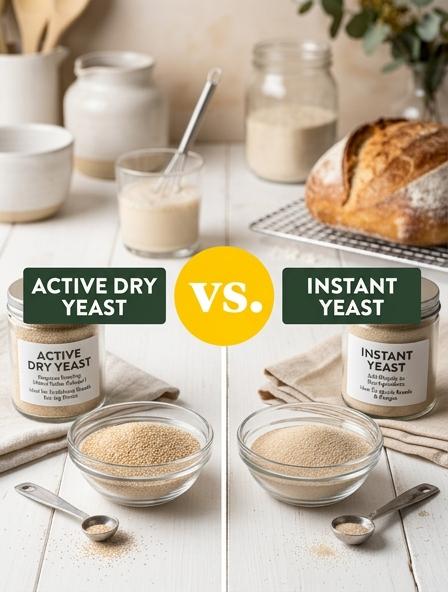
Rise Speed and Fermentation Efficiency Comparison
The primary difference between these leavening agents lies in their processing and metabolic rates. Instant yeast is manufactured with smaller granules and a higher percentage of live cells, allowing it to dissolve and produce carbon dioxide almost immediately upon contact with moisture. In contrast, active dry yeast contains larger granules encased in a layer of dead yeast cells, requiring a "blooming" phase in warm water to activate the dormant core.
- Instant Yeast: Highly efficient; reduces proofing time by up to 50% and can be mixed directly into dry ingredients.
- Active Dry Yeast: Slower fermentation; the gradual rise is often favored by bakers looking to develop complex organic acids and flavors over time.
Because instant yeast provides a more vigorous initial ferment, it is the more potent option, typically requiring 25% less volume than its active dry counterpart to achieve the same lift. You might reach for instant yeast when you need fluffy dinner rolls ready for a last-minute guest, while active dry is your go-to for a slow-risen, artisanal pizza crust.
Temperature Tolerance and Activation Procedures
The primary difference between these yeasts lies in their preparation requirements and heat sensitivity. Active dry yeast contains dormant cells that must be "bloomed" in warm water-ideally between 105°F and 115°F-to ensure vitality before mixing. Conversely, instant yeast is processed into finer granules, allowing it to bypass the soaking stage entirely.
| Yeast Type | Activation Requirement | Max Liquid Temp |
|---|---|---|
| Active Dry | Must be dissolved in liquid | 115°F |
| Instant | Mix directly with dry ingredients | 130°F |
Instant yeast is engineered for stability, remaining active even if added liquids are slightly hotter than standard proofing temperatures. You will likely prefer the convenience of instant yeast when baking a rapid-rise sandwich loaf on a busy afternoon to skip the traditional ten-minute blooming step.
Influence on Dough Texture and Crumb Density
The primary difference between active dry and instant yeast lies in fermentation speed and gas distribution, which directly impacts the finished loaf's crumb. Active dry yeast, characterized by larger granules and slower activity, often promotes a traditional, rustic texture with varied air pockets.
| Yeast Type | Crumb Characteristic | Texture Profile |
|---|---|---|
| Active Dry | Open, Irregular | Chewy and Substantial |
| Instant | Fine, Uniform | Soft and Light |
Instant yeast's rapid CO2 release ensures a tight, consistent cell structure, making it the favorite for home bakers who want to achieve that perfectly soft, even-textured slice of homemade sandwich bread for a midday snack.
Longevity and Shelf Stability in Home Storage
Both active dry and instant yeast are engineered for long-term shelf life, typically lasting up to two years when unopened in a cool, dry place. However, their stability diverges once the vacuum seal is broken. Active dry yeast consists of larger granules with a protective coating of dead yeast cells, providing a slight buffer against degradation. In contrast, instant yeast is more porous and highly sensitive to oxygen and moisture.
- Room Temperature: Unopened packets are stable for 12–24 months.
- Refrigeration: Extends the viability of opened yeast for 3–4 months.
- Freezing: Keeps yeast dormant and effective for 6 months or longer.
To ensure your dough always rises, many home bakers prefer storing their yeast in an airtight glass jar in the freezer, scooping out exactly what they need for a spontaneous batch of warm, crusty bread on a snowy afternoon.
Bread Machine Performance and Cycle Compatibility
Bread machines rely on precise timing for kneading and rising, making yeast selection critical for success. Instant yeast, frequently labeled as "bread machine yeast," consists of fine granules that dissolve and activate rapidly. This makes it the superior choice for "Quick" or "Rapid" cycles where fermentation time is limited.
Active dry yeast has larger granules and a slower fermentation onset. While it performs reliably in standard, longer cycles, it may result in a dense, under-proofed loaf if used in a high-speed setting without prior rehydration in warm water.
- Instant Yeast: Best for all cycles, especially 1-hour express settings.
- Active Dry Yeast: Best for dough or basic cycles exceeding three hours.
You can achieve a perfectly tall, airy loaf on a busy weeknight by choosing instant yeast for your machine's express cycle.
Manual Kneading Success and Elasticity Impact
The choice between active dry and instant yeast significantly influences how dough develops during manual kneading. Because active dry yeast consists of larger granules protected by dormant cells, it requires thorough rehydration. If not proofed correctly, undissolved granules can create "weak spots" in the gluten network, leading to tearing. Conversely, the fine particles of instant yeast integrate seamlessly, promoting rapid protein bonding and superior elasticity.
- Active Dry Yeast: Requires precise hydration to avoid a grainy texture during hand-kneading.
- Instant Yeast: Enhances the structural integrity of the dough by dispersing evenly among flour particles.
Achieving a smooth, supple dough depends on how effectively the yeast interacts with moisture to support the gluten matrix.
You will appreciate the immediate elasticity of instant yeast when hand-stretching a delicate pizza crust to achieve that perfect, translucent windowpane effect.
Rapid Rise versus Slow Fermentation Performance
The primary distinction in yeast performance lies in the speed of CO2 production and the necessity of rehydration. Instant yeast, often marketed as rapid rise, consists of fine particles that dissolve instantly, triggering an immediate fermentation cycle. This makes it highly efficient for "no-time" doughs or single-rise recipes. Conversely, active dry yeast consists of larger, dormant granules that require "blooming" in warm water. This slower start is actually an advantage for long-duration fermentation, as it allows enzymes more time to break down starches into complex sugars, resulting in superior crust color and a more nuanced aromatic profile.
- Instant Yeast: Engineered for speed, high-activity levels, and bypassing the first rise.
- Active Dry Yeast: Optimized for stability, steady gas release, and flavor development during cold-proofing.
You might reach for instant yeast when you need fluffy dinner rolls in a hurry, but you will prefer active dry when crafting an artisanal, slow-fermented baguette that requires deep, complex flavors.
Crust Development and Surface Quality Results
The physiological differences between active dry yeast (ADY) and instant yeast directly influence the Maillard reaction and the final texture of a loaf's exterior. Because active dry yeast consists of larger granules that ferment more slowly, it allows for a more prolonged enzymatic breakdown of starches. This often results in a deeper, more complex caramelization and a thicker, heartier crust.
- Active Dry Yeast: Typically produces a rustic, blistered, and crunchier surface due to extended proofing times.
- Instant Yeast: Yields a more uniform, thinner, and smoother crust, as the rapid gas production stretches the dough quickly.
Artisan bakers often reach for active dry yeast when they want to achieve that signature shattering, crackly crust on a sourdough-style boule during a slow, overnight cold ferment in the refrigerator.
Hydration Sensitivity and Mixing Methods
The primary distinction between active dry and instant yeast lies in their hydration requirements and granule structure. Active dry yeast consists of larger granules protected by a layer of dormant cells, necessitating a "proofing" stage. To activate it, you must dissolve the yeast in warm water (105°F–115°F) before adding it to flour. Conversely, instant yeast features smaller, more porous particles that hydrate rapidly, allowing for direct integration into dry ingredients.
- Active Dry Yeast: Requires 5–10 minutes of rehydration in liquid to ensure cell vitality.
- Instant Yeast: Engineered for "no-wait" mixing, bypassing the traditional blooming process.
While active dry yeast is sensitive to water temperature, it remains a favorite for bakers who enjoy the ritual of watching the yeast bloom to guarantee a successful rise in their artisanal loaves.
Digestive Impact and Fermentation Quality
The primary difference between active dry and instant yeast lies in their enzymatic activity and fermentation speed. Active dry yeast contains dormant cells that require rehydration, often resulting in a steadier, longer fermentation process. This extended duration allows for a more thorough breakdown of complex starches and gluten proteins, which can enhance overall digestibility.
- Active Dry Yeast: Slower fermentation allows for better reduction of phytic acid and deeper flavor development.
- Instant Yeast: Engineered for rapid CO2 production, it streamlines baking but offers less time for pre-digestive enzymatic action.
While both provide reliable leavening, the slower pace of active dry yeast is often favored for artisanal bakes that prioritize gut health and nutrient bioavailability. You might prefer using active dry yeast for a slow-fermented Sunday loaf to achieve that rich, artisanal flavor and a gut-friendly crust that your family loves.
Active Dry Yeast vs Instant Yeast source and external links
- Active Dry Yeast is a leavening agent consisting of coarse granules that typically must be dissolved in warm water to be activated before being added to dough.
- Instant Yeast features smaller granules that dissolve quickly, allowing it to be mixed directly into dry ingredients without the need for prior rehydration.