
Active Dry Yeast vs Instant Dry Yeast : Which is Best for Rise Speed, Dough Texture, and Flavor Nuances?
Rise Speed Variations in Home Dough Preparation
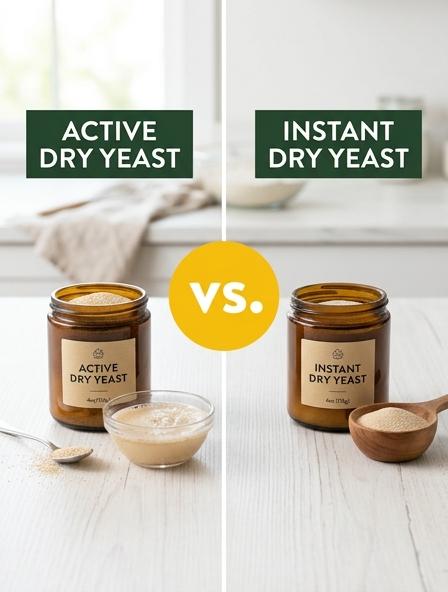
The primary difference between active dry and instant yeast lies in their processing and fermentation velocity. Active dry yeast features larger granules and requires "blooming" in warm water to reactivate the dormant cells, leading to a steady, moderate rise. In contrast, instant yeast is milled into smaller particles, allowing it to dissolve instantly and accelerate carbon dioxide production.
- Active Dry Yeast: Best for slow-fermented breads; requires rehydration before mixing.
- Instant Dry Yeast: Provides a 25% to 50% faster rise; can be mixed directly into dry ingredients.
Because instant yeast contains more live cells per gram, it shortens the proofing duration significantly. This makes it the preferred choice for modern home bakers seeking efficiency without sacrificing crumb structure. You might reach for instant yeast when you are short on time and need your homemade pizza dough to double in size in under forty minutes.
Texture and Crumb Results for Different Baking Methods
The choice between active dry and instant yeast significantly influences the crumb density and mouthfeel of your final bake. Active dry yeast requires rehydration, often producing a traditional, slightly irregular crumb structure typical of long-fermented artisanal breads. In contrast, instant yeast activates faster, resulting in a more uniform, fine-textured crumb favored for soft, commercial-style loaves.
- Artisanal Methods: Active dry yeast allows for gradual gluten development, creating a rustic, chewy texture.
- Rapid Baking: Instant yeast provides a quick, consistent lift, ideal for soft sandwich breads and dinner rolls.
- Cold Fermentation: Active dry yeast often yields more complex flavors during slow, refrigerated proofs.
Understanding these yeast behaviors allows you to manipulate the airiness and elasticity of your dough to match specific recipe goals. You might prefer the fine, pillowy softness of a brioche made with instant yeast when you need a reliable, high-quality result for a weekend family brunch.
Water Temperature and Hydration for Dry Leaveners
Hydration requirements differ significantly between yeast types. Active dry yeast consists of larger granules protected by a layer of dead yeast cells, necessitating a "blooming" phase in warm water to activate the living core. Conversely, instant dry yeast features smaller particles that hydrate rapidly, allowing for direct integration into flour without prior soaking.
- Active Dry Yeast: Requires water between 105°F and 115°F (40°C–46°C) for proper rehydration.
- Instant Dry Yeast: Performs best with liquid temperatures around 120°F to 130°F (49°C–54°C) when mixed directly with dry ingredients.
Temperature precision is vital; water that is too hot will kill the yeast, while excessively cold water prevents activation. You will love the convenience of skipping the proofing step with instant yeast when you are preparing a quick batch of homemade pizza dough on a busy Friday night.
Nutritional Impact of Fermentation Time on Daily Bread
The choice between active dry yeast and instant dry yeast significantly influences fermentation duration, which directly dictates the nutritional profile of your loaf. While instant yeast accelerates the baking process, the slower pace often required by active dry yeast allows for superior enzymatic activity.
- Mineral Bioavailability: Longer fermentation reduces phytic acid, an antinutrient that binds to minerals, making magnesium and iron easier for the body to absorb.
- Improved Digestibility: Extended rise times help pre-digest gluten proteins and complex starches, easing the load on your digestive system.
- Lower Glycemic Index: Slow-fermented breads typically result in a more stable blood sugar response compared to quick-rise versions.
Imagine the satisfaction of a weekend baker who chooses a slow overnight rise with active dry yeast to achieve a golden, gut-friendly crust that the whole family loves.
Vitality and Temperature Sensitivity of Fermenting Agents
The metabolic resilience of yeast depends heavily on its processing. Active dry yeast consists of large granules with a protective coating of dead cells, requiring "blooming" in warm water (105°F–110°F) to ensure vitality. Without this thermal bridge, the yeast may fail to fully hydrate. Conversely, instant dry yeast features smaller porous granules with higher live cell counts, allowing it to activate instantly without pre-soaking.
- Active Dry Yeast: High temperature sensitivity; requires precise rehydration to prevent dormancy.
- Instant Dry Yeast: Greater thermal stability; maintains high vitality when mixed directly with dry ingredients.
While both agents thrive at room temperature, instant yeast is engineered for a faster, more vigorous rise, making it less susceptible to slight temperature fluctuations in the kitchen. You will prefer the robust vitality of instant yeast when you want to skip the thermometer and mix dough immediately for a high-hydration focaccia.
Storage Stability and Shelf Life of Kitchen Essentials
Understanding the longevity of active dry versus instant yeast is crucial for consistent baking results. Active dry yeast consists of larger granules with a protective coating of dead yeast cells, whereas instant yeast features smaller particles and added conditioners for faster hydration. Both varieties are typically shelf-stable for up to two years when unopened and stored in a cool, dark environment.
- Opened Refrigeration: Remains potent for approximately four months.
- Freezer Storage: Extends viability up to six months or longer in an airtight container.
- Moisture Sensitivity: Humidity is the primary enemy of yeast dormancy and will cause rapid spoilage.
While instant yeast is often more resilient to temperature fluctuations during storage, always perform a bloom test if the expiration date has passed. You might choose to store a vacuum-sealed brick of instant yeast in your freezer to ensure those spontaneous batches of homemade pizza dough always rise perfectly.
Reliability and Performance in Daily Baking Tasks
Choosing the right yeast affects both the workflow and the predictability of your dough's rise. Active dry yeast consists of larger granules that must be dissolved in warm water-a process known as proofing-to verify activity before adding other ingredients. Instant dry yeast, however, is manufactured with smaller, porous granules, allowing it to hydrate rapidly and perform consistently when mixed directly into the flour.
| Feature | Active Dry Yeast | Instant Dry Yeast |
|---|---|---|
| Activation | Must proof in liquid | Add directly to dry |
| Rise Time | Slower, traditional | Fast and vigorous |
Many home bakers prefer the reliability of instant yeast when preparing a quick batch of fluffy dinner rolls to ensure a perfect rise even on a tight weeknight schedule.
Natural Flavor Nuances from Different Rising Processes
The choice between active dry and instant yeast significantly influences the sensory profile of your bread. Because active dry yeast requires a longer fermentation window, it allows more time for enzymatic activity to break down starches into complex sugars. This extended process facilitates the development of organic acids and esters, yielding a deep, traditional "yeasty" aroma and a more robust crumb.
In contrast, instant yeast is engineered for a rapid rise, which often bypasses these intricate biochemical stages. While efficient, the shorter fermentation period results in a milder, cleaner flavor profile where the natural taste of the flour remains front and center.
- Active Dry Yeast: Slower rise, complex fermentation notes, and artisanal depth.
- Instant Dry Yeast: Quick fermentation, subtle flavor, and consistent mildness.
You might choose active dry yeast when slow-proofing a rustic Dutch oven boule to capture those tangy, professional-grade undertones that only time can develop.
Determining Efficiency for Weekday Meal Preparation
When balancing a busy schedule, the choice between active dry yeast and instant dry yeast dictates your kitchen efficiency. Active dry yeast consists of larger granules and requires "blooming"-dissolving in warm water for 5 to 10 minutes-before use. In contrast, instant dry yeast features smaller particles and can be mixed directly with dry ingredients, bypassing the activation stage entirely.
| Characteristic | Active Dry Yeast | Instant Dry Yeast |
|---|---|---|
| Preparation | Requires hydration | Direct incorporation |
| Fermentation | Standard pace | Rapid action |
For maximum time-saving during the work week, instant yeast is the superior choice because it shortens the rising process. Home bakers love using instant yeast for "emergency" pizza dough, allowing them to go from raw ingredients to a hot, bubbly crust in under an hour after a long day at the office.
Effect of Rising Agents on Bread Appearance and Crust
The choice between active dry and instant yeast significantly influences the final aesthetic and texture of your loaf. Active dry yeast, characterized by its larger granules, often requires longer fermentation times, which can develop a deeper golden-brown hue and a thicker, rustic crust through increased enzymatic activity. Conversely, instant yeast features smaller particles that hydrate immediately, typically yielding a more uniform crumb structure and a thinner, more consistent crust.
- Active Dry Yeast: Creates a thicker, traditional crust with artisanal irregularities and a more pronounced browning.
- Instant Yeast: Produces a smoother, more uniform surface and a softer exterior, ideal for sandwich breads.
The rising agent dictates the intensity of the Maillard reaction, affecting both the coloration and the sensory experience of the bread's exterior. Imagine baking a crusty, sourdough-style boule where active dry yeast helps achieve that crackly, dark-golden shell that artisanal bread enthusiasts crave.
Active Dry Yeast vs Instant Dry Yeast source and external links
- Active Dry Yeast consists of coarse granules that must be dissolved in warm water to become active before being added to dough. Learn more about Active Dry Yeast.
- Instant Dry Yeast features smaller granules that can be mixed directly into dry ingredients without the need for prior rehydration. Read more about Instant Dry Yeast.