
Active Dry Yeast vs. Bread Machine Yeast: The Differences in Activation Requirements, Fermentation Speed, and Machine Compatibility.
Navigating the world of baking requires understanding the distinct roles of active dry yeast versus bread machine yeast to ensure a perfect rise. Active dry yeast consists of larger, dormant granules that require proofing-dissolving in warm liquid-to "wake up" before mixing. Conversely, bread machine yeast is a finely ground instant variety designed for direct integration with dry ingredients, skipping the manual activation step entirely. This distinction is vital for machine compatibility; the rapid fermentation of bread machine yeast perfectly suits quick automated cycles, while the slower pace of active dry yeast is better for traditional, hand-kneaded recipes. Mastering these activation and speed differences ensures your homemade bread achieves a consistent, airy crumb every single time.
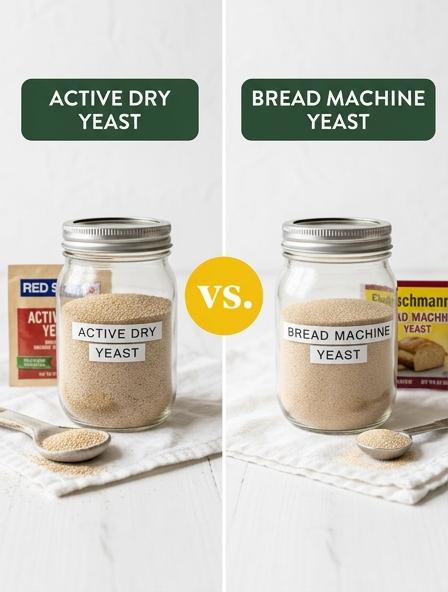
Impact of Particle Size on Dough Development
The physical dimensions of yeast granules significantly influence the fermentation timeline and dough structure. Active dry yeast features larger, encapsulated grains that require pre-hydration in warm liquid to dissolve a protective coating of dormant cells. In contrast, bread machine yeast is milled into much smaller particles, allowing for immediate activation upon contact with moisture.
This disparity in surface area directly dictates the speed of carbon dioxide production:
- Active Dry: Larger granules offer a slower, steady rise, which is beneficial for developing complex flavors in traditional recipes.
- Bread Machine Yeast: Finer particles facilitate rapid gas release, making it ideal for the high-speed environments of automated baking cycles.
You might prefer the fine-milled consistency of bread machine yeast when you are rushing to finish a crusty white loaf for dinner and need to skip the traditional proofing step.
Temperature Requirements for Proper Activation
Understanding the thermal sensitivity of yeast is essential for achieving the perfect rise. Active dry yeast consists of dormant living organisms that require rehydration in warm liquid to "wake up." If the water is too cool, the yeast won't activate; if it is too hot, the cells will perish. Bread machine yeast, a finer-grain instant yeast, is more thermally resilient when mixed directly with dry ingredients.
- Active Dry Yeast: Ideal liquid temperature is between 105°F and 115°F for proofing.
- Bread Machine Yeast: Can handle higher temperatures, typically 120°F to 130°F, when combined with flour.
Regardless of the type, temperatures exceeding 140°F will kill the yeast instantly, ruining your dough. You might prefer the ritual of proofing active dry yeast in a bowl to ensure it bubbles properly before committing to a long-fermented focaccia, whereas bread machine yeast is what you reach for when you need a reliable, fast-acting rise for a Tuesday night pizza crust.
Fermentation Speed and Rise Duration
The primary difference between Active Dry Yeast and Bread Machine Yeast lies in their metabolic activity and granule size. Active Dry Yeast consists of larger particles that require a longer activation period, leading to a slower fermentation process. This gradual pace is beneficial for traditional recipes requiring two separate rises to develop complex gluten structures. In contrast, Bread Machine Yeast is more finely milled and highly active, allowing it to hydrate instantly and accelerate the fermentation cycle.
| Feature | Active Dry Yeast | Bread Machine Yeast |
|---|---|---|
| Activation | Requires proofing in water | Directly added to flour |
| Rise Speed | Moderate (Longer duration) | Rapid (Shorter duration) |
Home bakers who want a fresh loaf of white bread ready in under two hours prefer Bread Machine Yeast for its ability to cut total prep time in half.
Compatibility with Automatic Baking Cycles
Choosing the right yeast depends heavily on your appliance's settings. Bread machine yeast is a fast-acting, finely granulated variety designed to activate instantly upon contact with moisture. This makes it ideal for the "set it and forget it" nature of automatic cycles. In contrast, active dry yeast has larger granules and a protective coating that usually requires "proofing" in warm water before use.
- Bread Machine Yeast: Specifically engineered for quick mixing and delayed start timers; no pre-hydration needed.
- Active Dry Yeast: Best for manual baking; if used in a machine, it may fail to fully dissolve or rise properly during short cycles.
While you can substitute active dry yeast by dissolving it first, this often defeats the convenience of a bread maker's programming. You might prefer bread machine yeast when you want to prep your ingredients before bed and use the delay-start feature to wake up to the aroma of a perfectly risen, golden-brown loaf.
Storage Stability and Potency Maintenance
The shelf life of yeast is determined by its granule size and manufacturing process. Active dry yeast consists of larger granules with a protective layer of dormant cells, offering moderate stability at room temperature. In contrast, bread machine yeast is more porous and highly active, making it significantly more sensitive to oxygen and humidity. Both varieties experience rapid oxidation once opened, which can lead to "sluggish" fermentation or total failure to rise.
- Airtight Sealing: Essential to prevent moisture from prematurely activating the cells.
- Temperature Control: Refrigeration slows cellular degradation effectively.
- Freezing: Suspends biological activity for long-term potency maintenance.
Many dedicated bread makers swear by storing their yeast in the back of the freezer to ensure their Sunday morning cinnamon rolls achieve a consistent, pillowy rise every single time.
Influence on Loaf Volume and Structure
The choice between active dry and bread machine yeast directly impacts the internal architecture of your bread. Bread machine yeast consists of finer particles that hydrate instantly, triggering rapid fermentation. This results in a significant initial boost in loaf volume and a soft, airy crumb. Conversely, active dry yeast has larger granules protected by dormant cells, requiring warm water activation. This slower process allows for more controlled gluten development, often yielding a sturdier structure and a classic, uniform texture.
- Bread Machine Yeast: Higher rise in shorter timeframes; lighter crumb density.
- Active Dry Yeast: Stronger structural integrity; ideal for slow-rise artisanal loaves.
Home bakers seeking a tall, pillowy sandwich loaf for the week's school lunches often prefer bread machine yeast for its reliable, high-volume performance.
Direct Mixing Versus Water Rehydration
The fundamental difference between these two leavening agents lies in their preparation requirements. Active dry yeast features larger granules with a protective coating of dead yeast cells, necessitating water rehydration (or blooming) before use. This involves dissolving the yeast in warm water to ensure it is alive and active. In contrast, bread machine yeast-a form of instant yeast-is specifically milled into finer particles designed for direct mixing.
- Active Dry Yeast: Requires a 5–10 minute proofing step in warm liquid.
- Bread Machine Yeast: Can be added directly to dry ingredients without prior soaking.
Because bread machine yeast hydrates faster, it is the standard choice for automated cycles where timing is precise. You might prefer the ritual of blooming active dry yeast to guarantee a perfect rise in a hand-crafted sourdough, while the time-pressed baker will choose bread machine yeast to skip the extra bowl and get the loaf started immediately.
Performance in Variable Proofing Environments
The primary difference in performance between these yeasts lies in their sensitivity to temperature and moisture. Active dry yeast consists of larger granules that remain dormant until rehydrated in warm water. This makes it highly effective for traditional, multi-stage proofing where slow fermentation is desired to develop deep flavors. In contrast, bread machine yeast features a finer grain and added ascorbic acid, allowing it to activate instantly upon contact with flour and liquid.
- Active Dry Yeast: Performs best in stable, warm environments and is ideal for long, cold fermentation in the refrigerator.
- Bread Machine Yeast: Engineered to thrive in the rapid, high-heat cycles of a bread maker, skipping the initial proofing stage entirely.
Home bakers often prefer active dry yeast for hand-kneaded artisanal boules, while busy families rely on the speed of bread machine yeast to have a fresh sandwich loaf ready before the school run.
Nutritional Profile and Digestive Impact
Both active dry and bread machine yeast are strains of Saccharomyces cerevisiae, sharing an identical nutritional foundation. They are naturally rich in B-complex vitamins, such as thiamine and riboflavin, and essential minerals like selenium and zinc. While their caloric contribution is negligible, their biological activity significantly enhances the digestibility of the flour they ferment.
The primary difference lies in the grain size and processing. Bread machine yeast is more finely granulated and often contains ascorbic acid (Vitamin C) to accelerate the rising process. This rapid fermentation helps break down complex starches and gluten proteins more efficiently during short cycles, which can be beneficial for those with mild sensitivities.
- B-Vitamins: Supports cellular energy metabolism.
- Protein: Provides a small boost of essential amino acids.
- Bioavailability: Fermentation reduces phytates in grains, improving mineral absorption.
You might prefer bread machine yeast for a "quick bake" setting to ensure the dough rises fully and remains light on your stomach without the risk of under-fermentation bloating.
Consistency in Crumb Pattern and Crust Texture
The choice between Active Dry Yeast and Bread Machine Yeast directly influences the final crumb structure and crust development of your loaf. Bread Machine Yeast, characterized by its fine granules, dissolves rapidly to create a uniform, tight crumb pattern ideal for sandwich slices. In contrast, Active Dry Yeast often yields a more varied internal structure.
- Active Dry Yeast: Requires proofing; produces an open, rustic crumb and a thicker, heartier crust through longer fermentation.
- Bread Machine Yeast: Added directly to dry ingredients; ensures high consistency and a softer, thinner crust tailored for rapid rising.
Because Bread Machine Yeast (a form of instant yeast) includes ascorbic acid as a dough conditioner, it provides a more predictable volume. Active Dry lacks these conditioners, allowing for a slower rise that many artisans feel improves the "chew" and complexity of the crust.
You might prefer Bread Machine Yeast when you want a perfectly even, soft-crusted white loaf that holds up beautifully to heavy sandwich fillings during a busy school week.
Active Dry Yeast vs Bread Machine Yeast source and external links
- Active dry yeast is a common leavening agent that typically requires dissolving in warm liquid to activate before being added to dough. Active Dry Yeast
- Bread machine yeast is a fast-acting, finely granulated variety designed to be mixed directly with dry ingredients for quick and efficient rising. Bread Machine Yeast